Surface Tension, Capillarity & Droplet / Bubble / Jet Mechanics
In this chapter (4 topics)
On this page
- 1. Topic Metadata & Syllabus Mapping
- 2. Executive Summary & Core Engineering Concepts
- 3. Comprehensive Technical Principles & Mechanics
- 3.1 Surface Tension Definitions & Energetics
- 3.2 Young-Laplace Equation for Interfacial Pressure Differences
- 3.3 Contact Angle (θ) and Wetting Characteristics
- 3.4 Capillarity: Jurin's Law Formulation
- 4. Detailed Technical Diagrams & Visual Models
- 4.1 Molecular Origin & Young-Laplace Equilibrium in Droplet, Bubble & Jet
- 4.2 Capillary Rise & Depression (Jurin's Law & Contact Angle)
- 5. Comprehensive Step-by-Step Mathematical Derivations
- 5.1 Derivation of Excess Pressure in a Liquid Droplet
- 5.2 Derivation of Excess Pressure in a Soap Bubble
- 5.3 Derivation of Excess Pressure in a Cylindrical Liquid Jet
- 6. Three Fully Worked Unit-Checked Numerical Examples
- Example 1: Excess Pressure inside a Raindrop, Soap Bubble & Fog Droplet
- Example 2: Capillary Rise in Water Tube & Piezometer Sizing
- Example 3: Capillary Depression of Mercury in an Unequal-Leg U-Tube Manometer
- 7. Common Engineering Pitfalls & Examination Traps
- 8. Real-World Case Studies & Engineering Applications
- Geotechnical Engineering: Capillary Siphonage & Soil Negative Pore Pressure
- 9. Competitive Examination Practice Problems
- Problem 1 (GATE CE - 1 Mark)
- Problem 2 (UPSC ESE Paper-II - 2 Marks)
- Problem 3 (SSC JE - 1 Mark)
- Problem 4 (State PSC AE - 2 Marks)
- Problem 5 (RRB JE - 1 Mark)
- 10. Cross-Subject Synthesis & Advanced Fluid Couplings
- 11. Standard Reference Textbooks & Official Code Specifications
- 12. Comprehensive Summary, Formula Cheatsheet & Key Takeaways
1. Topic Metadata & Syllabus Mapping
| Attribute | Specification |
|---|---|
| Module / Topic ID | FM-01-04 |
| Subject | Fluid Mechanics & Hydraulic Machinery |
| Chapter | 01: Fluid Properties & Rheology |
| Topic Title | Surface Tension, Capillarity & Droplet / Bubble / Jet Mechanics |
| Primary Reference Standards | Young-Laplace Equation, Jurin's Law, IS 4987, Frank M. White (Fluid Mechanics), Fox & McDonald, Modi & Seth (Hydraulics and Fluid Mechanics) |
| Target Competitive Examinations | GATE CE, UPSC ESE (Paper-II), SSC JE, State PSC AE/JE, RRB JE |
| Examination Weightage | GATE (1 to 2 Marks), UPSC ESE (4 to 8 Marks prelims/mains), SSC JE (2 to 4 Marks), State AE/JE (2 to 4 Marks) |
| Prerequisites | FM-01-01 (Fluid Properties), Engineering Mechanics (Force Equilibrium) |
2. Executive Summary & Core Engineering Concepts
At the interface between two immiscible fluids (such as liquid and gas), intermolecular cohesive and adhesive forces become unbalanced, producing two quintessential interfacial phenomena:
-
Surface Tension ( or ):
Liquid molecules deep in the bulk fluid experience uniform, isotropic attractive forces from neighboring molecules in all directions, yielding zero net resultant force. However, molecules situated on the free surface lack liquid neighbors above them and experience a persistent net inward cohesive pull directed toward the bulk liquid. Consequently, the liquid surface contracts spontaneously to the minimum possible surface area (forming spheres in the absence of external forces) and behaves as a stretched elastic membrane under uniform tensile stress.- Tensile Force per Unit Length: (, dimensions or ).
- Surface Free Energy: Work required to expand the surface area by unit amount: ().
- Temperature Sensitivity: As temperature increases, thermal molecular agitation expands intermolecular distances, weakening cohesive attractions; hence, surface tension decreases with increasing temperature, vanishing entirely at the critical point ( at ).
-
Excess Internal Pressure (Young-Laplace Balance):
To equilibrate the inward tensile hoop pull of surface tension, the internal pressure of a curved fluid interface must exceed the external ambient pressure ():- Liquid Droplet (1 interface):
- Soap Bubble (2 interfaces - inner & outer film):
- Liquid Jet (Cylindrical):
-
Capillarity & Jurin's Law:
When a narrow glass tube is inserted into a liquid, the relative balance between cohesion (intermolecular attraction between liquid molecules) and adhesion (attraction between liquid molecules and the solid glass boundary) establishes the contact angle and dictates meniscus curvature:- Wetting Liquid (): Concave upward meniscus; the liquid climbs above the free reservoir surface (Capillary Rise), as seen in water on clean glass ().
- Non-Wetting Liquid (): Convex upward meniscus; the liquid surface is depressed below the free reservoir surface (Capillary Depression), as seen in mercury on glass ().
- Jurin's Law: (inversely proportional to diameter ).
- Piezometer Design Mandate: Piezometer tubes must have an internal diameter to suppress capillary meniscus errors to .
3. Comprehensive Technical Principles & Mechanics
3.1 Surface Tension Definitions & Energetics
+-----------------------------------------------------------------------------------+
| TWO EQUIVALENT DEFINITIONS OF SURFACE TENSION (σ):                               |
|                                                                                   |
| 1. Mechanical Force Perspective:                                                  |
|    - Tensile force exerted across an imaginary line of unit length drawn on the   |
|      free liquid surface:                                                         |
|      sigma = F / L  [N/m]                                                         |
|                                                                                   |
| 2. Thermodynamic Energy Perspective:                                              |
|    - Work required to create new surface area under isothermal conditions:        |
|      sigma = dW / dA  [J/m^2 = (N*m)/m^2 = N/m]                                   |
|                                                                                   |
| Dimensions: [M T^-2] or [F L^-1]                                                 |
| Benchmark: Clean Water at 20°C: sigma ≈ 0.0728 N/m ≈ 0.073 N/m                   |
|            Mercury at 20°C:     sigma ≈ 0.485 N/m (~6.7x higher than water!)      |
+-----------------------------------------------------------------------------------+
Effect of Temperature and Contaminants:
- Temperature: Intermolecular cohesion decreases approximately linearly with temperature: At the critical temperature (), the liquid-vapor density difference vanishes and .
- Chemical Additives:
- Surfactants (Soaps, Detergents): Dramatically decrease surface tension by adsorbing at the interface and disrupting water hydrogen bonds (drops from to ).
- Inorganic Salts (NaCl): Slightly increase the surface tension of water due to strong ion-dipole hydration forces.
3.2 Young-Laplace Equation for Interfacial Pressure Differences
For an arbitrary curved fluid membrane with two orthogonal principal radii of curvature and , the pressure jump across the interface is given by the general Young-Laplace Equation:
                   YOUNG-LAPLACE GEOMETRIC DERIVATIONS

  (a) Spherical Droplet (R1 = R2 = R):
      Δp = σ (1/R + 1/R) = 2σ/R = 4σ/d

  (b) Soap Bubble (2 surfaces, each with R1 = R2 = R):
      Δp = 2 * [2σ/R] = 4σ/R = 8σ/d

  (c) Cylindrical Liquid Jet (R1 = R, R2 = ∞):
      Δp = σ (1/R + 1/∞) = σ/R = 2σ/d
3.3 Contact Angle () and Wetting Characteristics
At the three-phase contact line where solid (), liquid (), and vapor () meet, the equilibrium contact angle is determined by Young's Equation:
Where are the respective solid-vapor, solid-liquid, and liquid-vapor interfacial surface free energies.
| Wetting Regime | Contact Angle | Meniscus Curvature | Force Dominance | Typical Fluid-Solid Pairs | Capillary Response |
|---|---|---|---|---|---|
| Complete Wetting | Strong Concave | Adhesion Cohesion | Pure water on clean glass | Maximum Rise | |
| Partial Wetting | Concave Upward | Adhesion Cohesion | Water on soiled glass, kerosene | Capillary Rise | |
| Neutral Boundary | Flat () | Adhesion = Cohesion | Pure water on clean paraffin wax | Zero Rise/Fall () | |
| Non-Wetting | Convex Upward | Cohesion Adhesion | Mercury on clean glass () | Capillary Depression | |
| Complete Non-Wetting | Spherical Bead | Cohesion Adhesion | Superhydrophobic coatings | Maximum Depression |
3.4 Capillarity: Jurin's Law Formulation
Consider a circular glass capillary tube of internal diameter () placed vertically in a liquid reservoir of density and surface tension .
- The contact line along the interior circumference is .
- The surface tension force acts upward along the meniscus rim at angle to the tube wall:
- This upward vertical tension equilibrates the weight of the elevated liquid column of height :
- Equating :
- When (water): (Capillary Rise).
- When (mercury): (Capillary Depression).
Capillary Rise Between Two Parallel Vertical Plates:
For two flat glass plates spaced distance apart and width :
- Upward surface tension acts along both inner faces (length ):
- Weight of elevated liquid slab:
- Equating: Key Exam Fact: For equal spacing (), the capillary rise between parallel plates is exactly half of that inside a circular capillary tube ().
4. Detailed Technical Diagrams & Visual Models
4.1 Molecular Origin & Young-Laplace Equilibrium in Droplet, Bubble & Jet
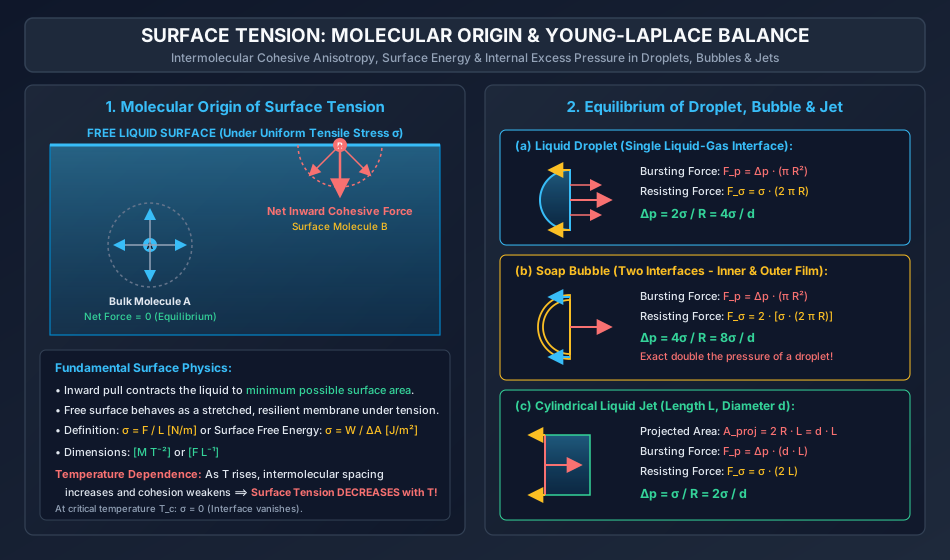
The following hand-coded engineering diagram displays the microscopic molecular cohesive imbalance at the free surface, alongside the three classical free-body force balances deriving the excess pressure in a liquid droplet, a soap bubble, and a cylindrical jet.
4.2 Capillary Rise & Depression (Jurin's Law & Contact Angle)
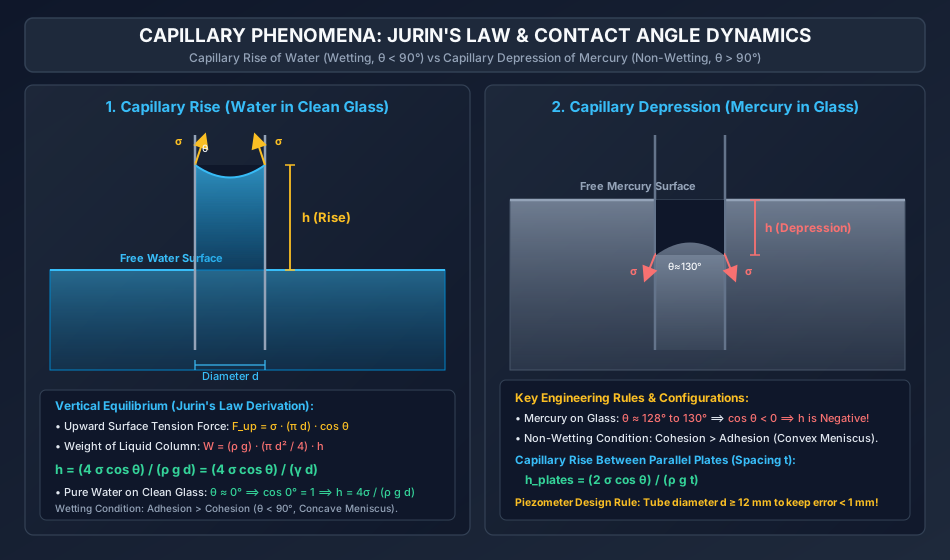
The following diagram illustrates the physical mechanics of capillary rise for water (, concave meniscus) versus capillary depression for mercury (, convex meniscus), vertical force equilibrium, and the parallel plate configuration.
5. Comprehensive Step-by-Step Mathematical Derivations
5.1 Derivation of Excess Pressure in a Liquid Droplet
Consider a spherical liquid droplet of radius () in equilibrium with the atmosphere. Cut the droplet through its diametral plane into two equal hemispheres:
- Bursting Pressure Force ():
The excess internal pressure acts across the projected circular diametral area : - Resisting Surface Tension Force ():
Surface tension acts along the perimeter of the cut boundary (): - Equilibrium Condition (): Dividing both sides by :
5.2 Derivation of Excess Pressure in a Soap Bubble
A hollow soap bubble consists of a thin spherical liquid film enclosing an air pocket, suspended in ambient air:
- The soap film possesses two distinct liquid-air interfaces: an inner interface of radius and an outer interface of radius .
- Bursting Pressure Force:
- Resisting Surface Tension Force:
Tensile force is exerted simultaneously along BOTH inner and outer perimeters: - Equilibrium Condition: Crucial Principle: The excess pressure inside a soap bubble is exactly twice that inside a liquid droplet of identical diameter!
5.3 Derivation of Excess Pressure in a Cylindrical Liquid Jet
Consider a continuous cylindrical jet of liquid of diameter and length discharging into air. Consider a half-cylinder of length :
- Projected Area:
The projected area across the horizontal longitudinal diametral plane is . - Bursting Pressure Force:
- Resisting Surface Tension Force:
Surface tension acts along the two longitudinal cut edges, each of length (total length ): - Equilibrium Condition:
6. Three Fully Worked Unit-Checked Numerical Examples
Example 1: Excess Pressure inside a Raindrop, Soap Bubble & Fog Droplet
Problem Statement:
- Calculate the gauge pressure (excess internal pressure ) inside a spherical raindrop of diameter suspended in air. Surface tension of water . Express the pressure in and in equivalent millimeters of water column.
- Determine the excess pressure inside a hollow soap bubble of diameter formed from a soap solution with surface tension .
- Calculate the excess pressure inside an ultra-fine water droplet in an atmospheric fog cloud with diameter () and surface tension .
Step-by-Step Solution:
Step 1: Raindrop Calculation A raindrop has one liquid-air interface:
Equivalent head of water:
Step 2: Soap Bubble Calculation A soap bubble has two liquid-air interfaces (inner and outer surfaces):
Equivalent head of water:
Step 3: Fog Micro-Droplet Calculation
Equivalent head of water:
Physical Insight: Microscopic droplets sustain enormous internal overpressures (), explaining why micro-droplets strongly resist coalescence in colloidal mists and clouds!
Example 2: Capillary Rise in Water Tube & Piezometer Sizing
Problem Statement:
- A clean vertical glass capillary tube of internal diameter is lowered into clean water at (, contact angle , density ). Calculate the capillary rise in .
- In hydraulic laboratory testing, open glass piezometer tubes are used to measure pressure head. If the maximum allowable measurement error due to capillary rise must not exceed , determine the minimum required internal diameter of the piezometer tube.
Step-by-Step Solution:
Step 1: Capillary Rise in 2.0 mm Tube Using Jurin's Law:
Given:
The meniscus rises above the free water level.
Step 2: Minimum Piezometer Diameter for Tolerable Error Rearranging Jurin's formula to solve for tube diameter :
Substitute :
To keep capillary meniscus error strictly under , the piezometer tube must have an internal diameter .
(Standard code practice per IS 4987 mandates for general piezometers where capillary rise is accepted or corrected).
Example 3: Capillary Depression of Mercury in an Unequal-Leg U-Tube Manometer
Problem Statement:
A differential U-tube manometer contains mercury (, , contact angle ). Due to manufacturing tolerances, the two vertical limbs have slightly unequal internal diameters:
- Left Limb Diameter:
- Right Limb Diameter:
- Calculate the capillary depression in each limb in .
- Determine the false differential head error introduced purely by unequal capillary depression when both limbs are open to the atmosphere.
Step-by-Step Solution:
Step 1: Trigonometric Term
Specific weight of mercury:
Step 2: Capillary Depression in Limb 1 ()
The mercury surface in the tube is depressed by .
Step 3: Capillary Depression in Limb 2 () Since , the depression is exactly half:
The mercury surface in the tube is depressed by .
Step 4: Differential Meniscus Error
Converting this error to equivalent head of water:
Practical Conclusion: Unequal manometer tube bores create significant false pressure readings. U-tube manometers must have identically matched bores with to eliminate differential capillary errors!
7. Common Engineering Pitfalls & Examination Traps
| Pitfall / Exam Trap | Erroneous Concept | Correct Physical & Code Principle |
|---|---|---|
| Trap 1: Droplet vs Bubble Pressure Multiplier | Using indiscriminately for soap bubbles. | A liquid droplet has one interface (). A soap bubble has two concentric interfaces (inner & outer), doubling the resisting force: ! |
| Trap 2: Radius vs Diameter Confusion in Formulas | Confusing and in the numerator of Laplace equations. | Remember: (Droplet) and (Bubble). If the question gives radius, use ; if diameter, use ! |
| Trap 3: Capillary Rise in Parallel Plates vs Circular Tubes | Using for parallel plates. | In a circular tube, circumference is for area (ratio ). For plates of spacing , wetted perimeter is for area (ratio ). Hence, , exactly half the tube value! |
| Trap 4: Mercury Capillary Sign Error | Treating mercury capillarity as a positive rise. | For mercury on glass, . The meniscus is convex and drops below the reservoir surface (Depression). |
| Trap 5: Temperature Trend of Surface Tension | Assuming surface tension increases with temperature. | Intermolecular cohesive bonds expand and weaken with heating. Surface tension decreases monotonically with temperature, reaching zero at the critical point. |
8. Real-World Case Studies & Engineering Applications
Geotechnical Engineering: Capillary Siphonage & Soil Negative Pore Pressure
- Context: In unsaturated soil mechanics and slope stability engineering, fine-grained silts and clays act as a dense network of microscopic capillary tubes formed by interconnected pore channels ().
- Mechanics:
- Water rises above the regional groundwater table through capillary suction into the capillary fringe:
- For a silt with pore diameter :
- This capillary water is held in a state of negative pore water pressure (suction) (), generating an apparent cohesion that stabilizes steep vertical excavation trenches in damp sand (sandcastle effect).
- Failure Case: When torrential monsoon rains fully submerge the capillary fringe, the menisci flatten (, radii ), suction vanishes (), apparent cohesion collapses instantly, triggering sudden shallow landslides along road embankments.
9. Competitive Examination Practice Problems
Problem 1 (GATE CE - 1 Mark)
The excess pressure inside a soap bubble of diameter and surface tension is:
- (A)
- (B)
- (C)
- (D)
Correct Answer: (C)
Step-by-Step Explanation:
A soap bubble consists of a hollow spherical shell having two surfaces (inner and outer).
Force balance: .
Problem 2 (UPSC ESE Paper-II - 2 Marks)
If a liquid has a contact angle with a glass surface, it indicates that:
- (A) Cohesive forces are weaker than adhesive forces
- (B) Cohesive forces are stronger than adhesive forces
- (C) The liquid forms a concave meniscus in a capillary tube
- (D) The liquid completely wets the glass surface
Correct Answer: (B)
Step-by-Step Explanation:
When cohesion (liquid-liquid attraction) exceeds adhesion (liquid-glass attraction), the liquid minimizes contact with the solid, forming an obtuse contact angle , a convex meniscus, and capillary depression.
Problem 3 (SSC JE - 1 Mark)
The height of capillary rise in a glass tube of diameter is:
- (A) Directly proportional to diameter
- (B) Inversely proportional to diameter
- (C) Independent of diameter
- (D) Inversely proportional to
Correct Answer: (B)
Step-by-Step Explanation:
From Jurin's Law, . Capillary rise is strictly inversely proportional to the diameter of the tube.
Problem 4 (State PSC AE - 2 Marks)
Two parallel vertical clean glass plates separated by a gap are immersed in water. The capillary rise between the plates is:
- (A)
- (B)
- (C)
- (D)
Correct Answer: (B)
Step-by-Step Explanation:
Vertical equilibrium: .
Problem 5 (RRB JE - 1 Mark)
With an increase in temperature, the surface tension of a liquid:
- (A) Increases
- (B) Decreases
- (C) Remains constant
- (D) First increases and then decreases
Correct Answer: (B)
Step-by-Step Explanation:
Heating increases thermal molecular agitation, expanding intermolecular spacing and weakening cohesive attractions; hence, surface tension decreases with temperature.
10. Cross-Subject Synthesis & Advanced Fluid Couplings
                             CROSS-DISCIPLINARY COUPLING

    Surface Tension & Capillarity (FM-01-04)
    - Jurin's Law: h = 4 sigma cos(theta) / (rho * g * d)
    - Young-Laplace Pressure: Delta p = 4 sigma / d
                         |
                         v
    Geotechnical Engineering & Soil Mechanics (SUB-09)
    - Capillary Fringe & Negative Pore Water Suction (Terzaghi's effective stress sigma' = sigma - u_w)
    - Bulking of Damp Sand (Interparticle meniscus tension resists packing)
                         |
                         v
    Concrete Technology & Building Materials (SUB-04)
    - Capillary Water Absorption (Sorptivity test per ASTM C1585)
    - Air-Entraining Agents (Modifying surface tension to form microscopic freeze-thaw relief voids)
11. Standard Reference Textbooks & Official Code Specifications
- Frank M. White: Fluid Mechanics, 8th Edition, McGraw-Hill Education, Chapter 1: Surface Tension and Capillarity.
- P.N. Modi & S.M. Seth: Hydraulics and Fluid Mechanics Including Hydraulic Machines, Standard Book House, New Delhi, Chapter 1: Surface Tension and Capillarity.
- Robert W. Fox, Alan T. McDonald, Philip J. Pritchard: Introduction to Fluid Mechanics, 9th Edition, John Wiley & Sons.
- K.L. Kumar: Engineering Fluid Mechanics, S. Chand Publishing, New Delhi, Chapter 1: Fluids and Their Properties.
- IS 4987: Recommendations for Design and Installation of Flow Measurement Devices, Bureau of Indian Standards, New Delhi.
12. Comprehensive Summary, Formula Cheatsheet & Key Takeaways
===================================================================================================
                       SURFACE TENSION & CAPILLARITY FORMULA CHEATSHEET
===================================================================================================
1. Surface Tension (sigma):
   - Definition:          sigma = F / L  [N/m]  or  sigma = dW / dA  [J/m²]
   - Dimensions:          [M T⁻²] or [F L⁻¹]
   - Water @ 20°C:        sigma ≈ 0.073 N/m
   - Mercury @ 20°C:      sigma ≈ 0.485 N/m
   - Temperature Trend:   sigma DECREASES as Temperature increases (sigma = 0 at T_critical)

2. Excess Internal Pressure (Young-Laplace Equation):
   - Liquid Droplet (1 interface):     Delta p = 2 sigma / R = 4 sigma / d
   - Soap Bubble (2 interfaces):       Delta p = 4 sigma / R = 8 sigma / d
   - Liquid Jet (Cylindrical):         Delta p = sigma / R   = 2 sigma / d

3. Contact Angle (theta) & Wetting:
   - Wetting Liquid (Water on glass):  theta < 90° (theta ≈ 0° for clean water) -> Concave Meniscus
   - Non-Wetting (Mercury on glass):   theta > 90° (theta ≈ 130°)              -> Convex Meniscus

4. Capillary Rise / Depression (Jurin's Law):
   - Circular Tube (diameter d):       h = (4 * sigma * cos theta) / (rho * g * d)
     * For Water (theta = 0°):         h = (4 * sigma) / (rho * g * d)  [Rise]
     * For Mercury (theta = 130°):     h is NEGATIVE                   [Depression]
   - Parallel Plates (gap t):          h = (2 * sigma * cos theta) / (rho * g * t) = h_tube / 2

5. Piezometer Design Mandate:
   - Minimum Tube Diameter:            d >= 12 mm (Suppresses capillary error to < 1 mm)
===================================================================================================