Energy methods represent the most mathematically rigorous and unifying approach to structural mechanics. In the 1860s and 1870s, three European engineers and mathematicians established the bedrock theorems that govern elastic structural analysis:
James Clerk Maxwell (1864): Discovered the reciprocal deflection relationship for elastic structures (fij=fji), proving that flexibility matrices are strictly symmetric.
Enrico Betti (1872): Generalized Maxwell's work into the theorem of reciprocal work for arbitrary multi-force systems (∑PiΔi′=∑Pi′Δi).
Carlo Alberto Castigliano (1873, published 1879): Formulated the two fundamental energy differentiation theorems in his masterwork Théorie de l'équilibre des systèmes élastiques, revolutionizing the analysis of statically indeterminate bridges and roof trusses.
Together with the Unit Load Method, Castigliano's Theorems and Reciprocal Laws form the direct bridge between classical manual force analysis and modern computerized finite element formulations.
2. Fundamental Energy Formulations: U vs U∗
2.1 Strain Energy (U) and Complementary Strain Energy (U∗)
Consider a general elastic body subjected to generalized forces P1,P2,…,Pn producing corresponding generalized displacements Δ1,Δ2,…,Δn:
Force P ^
        |         /
     P₁ +--------*
        |       /|
        |  U*  / |
        |     /  |  U
        |    /   |
      0 +---*----+-----> Displacement Δ
            0   Δ₁
Strain Energy (U): The work done by internal stresses during deformation, expressed as a function of displacements:
U(Δ1,Δ2,…,Δn)=∫V(∫0ϵσ:dϵ)dV
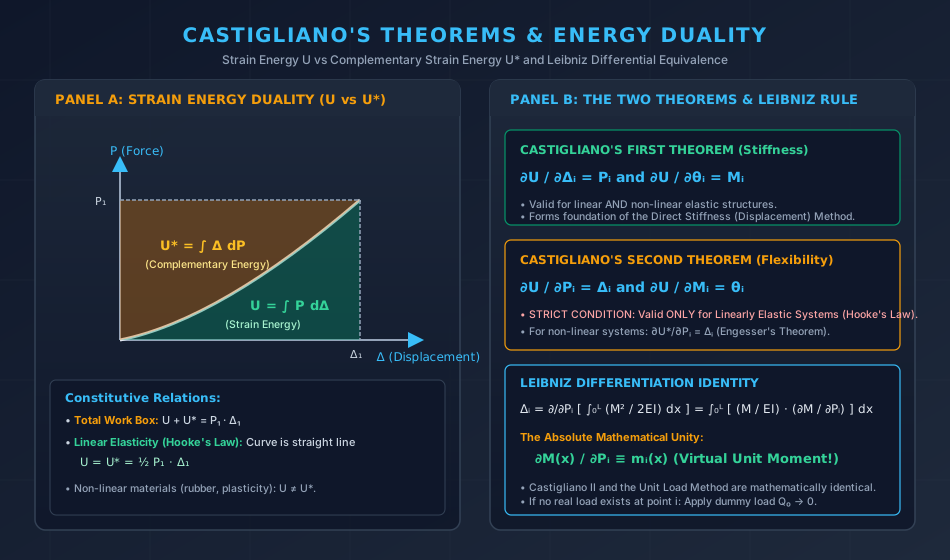
Geometrically, U is the area under the load-displacement curve (U=∫PdΔ).
Complementary Strain Energy (U∗): The dual energy potential, expressed as a function of forces:
U∗(P1,P2,…,Pn)=∫V(∫0σϵ:dσ)dV
Geometrically, U∗ is the area above the load-displacement curve (U∗=∫ΔdP).
2.2 The Energy Conservation Duality Law
The sum of strain energy and complementary strain energy equals the total rectangular bounding work box:
U+U∗=i=1∑nPiΔi
Linear vs Non-Linear Elasticity:
Linearly Elastic Material (Hooke's Law): The load-displacement curve is a straight line (P=KΔ). The diagonal splits the bounding rectangle into two equal triangles:
U=U∗=21i=1∑nPiΔi=21∫0LEIM2dx+21j=1∑mAjEjPj2Lj
Non-Linearly Elastic Material: If P∝Δn (n=1), the curve is non-linear. Therefore, U=U∗, and ordinary energy formulas must strictly distinguish between U and U∗.
3. Castigliano's First Theorem (Stiffness Formulation)
3.1 Theorem Statement
Castigliano's First Theorem: For any elastic structure (whether linearly or non-linearly elastic) supported in a manner that prevents rigid-body motion and kept at constant temperature, the first partial derivative of the total strain energy U with respect to any particular displacement Δi equals the generalized force Pi acting at that point in the direction of Δi:
∂Δi∂U=Piand∂θi∂U=Mi
3.2 Proof via Virtual Displacements
Let the structure undergo an infinitesimal virtual variation in displacement δΔi while all other displacements are held fixed:
Change in external work: δWext=Pi⋅δΔi
Change in internal strain energy: δU=∂Δi∂U⋅δΔi
By conservation of energy (δWext=δU):
Pi⋅δΔi=∂Δi∂U⋅δΔi⟹Pi=∂Δi∂U
Engineering Implication: Castigliano's First Theorem forms the foundation of the Displacement / Direct Stiffness Method and Finite Element Formulations, because it expresses forces in terms of known or unknown nodal displacements:
{P}=[K]{Δ}whereKij=∂Δi∂Δj∂2U
4. Castigliano's Second Theorem (Flexibility Formulation)
4.1 Theorem Statement
Castigliano's Second Theorem: In any linearly elastic structure at constant temperature with unyielding supports, the first partial derivative of the total strain energy U with respect to any external applied force Pi equals the displacement Δi of the point of application of that force along its line of action:
∂Pi∂U=Δiand∂Mi∂U=θi
For non-linearly elastic materials, this theorem is valid only when expressed in terms of Complementary Strain Energy U∗ (known historically as Engesser's Theorem, 1889):
∂Pi∂U∗=Δi
4.2 Leibniz Differentiation Under the Integral Sign
Evaluating total strain energy U=∫0L2EIM2dx and then differentiating with respect to Pi can become unwieldy. By applying Leibniz's rule for differentiation under the integral sign:
4.3 The Mathematical Identity between Castigliano II and the Unit Load Method
Notice the physical meaning of the term ∂Pi∂M(x):
If M(x) is a linear function of applied load Pi, the derivative ∂Pi∂M(x) represents the bending moment produced when Pi increases by unity (1.0).
This is identically equal to the virtual unit moment mi(x) in the Dummy Unit Load Method:
∂Pi∂M(x)≡mi(x)and∂Pi∂Pj≡kj
Thus, Castigliano's Second Theorem and the Unit Load Method are mathematically identical for linearly elastic systems!
4.4 The Dummy / Fictitious Load Technique (Q0→0)
If a deflection or rotation is required at a point or in a direction where no real load exists:
Apply an imaginary fictitious load Q0 (or moment M0) at that point in the desired direction.
Formulate the bending moment M(x,Q0) including Q0.
Differentiate before integration: ∂Q0∂M(x,Q0).
Set Q0=0 inside the integrand prior to performing the integration:
Δ=∫0LEIM(x,Q0)(∂Q0∂M(x,Q0))dxQ0=0
This eliminates messy algebraic terms and avoids squaring large expressions.
5. Betti's Reciprocal Work Theorem (1872)
5.1 Theorem Statement
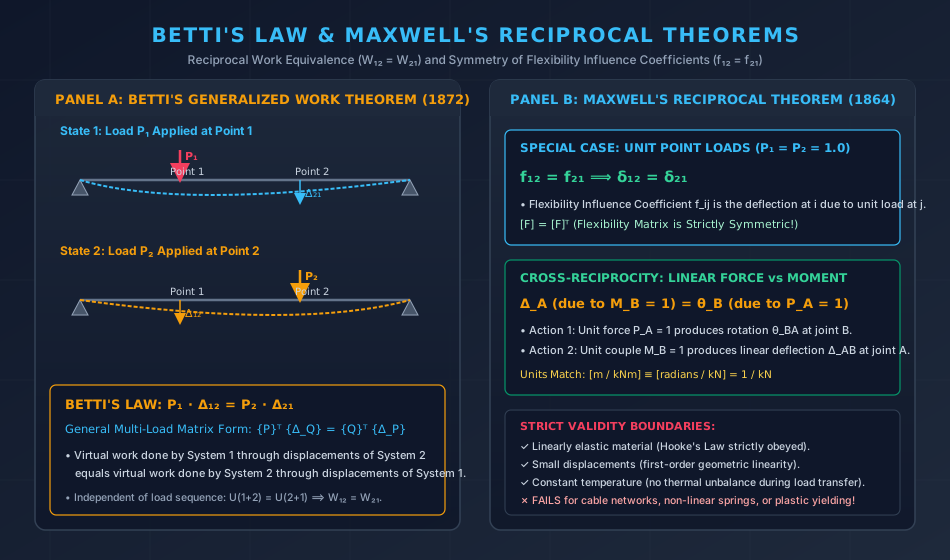
Betti's Law (Generalized Reciprocal Work Theorem): In any linearly elastic structure at constant temperature with unyielding supports, if two independent, separate equilibrium systems of forces {P} and {Q} act upon the structure, the virtual work done by the forces of System {P} acting through the displacements produced by System {Q} equals the virtual work done by the forces of System {Q} acting through the displacements produced by System {P}:
i=1∑nPi⋅ΔQ,i=j=1∑mQj⋅ΔP,j
In matrix notation:
{P}T{ΔQ}={Q}T{ΔP}
System 1 (P-System):           System 2 (Q-System):
    ↓ P₁                           ↓ Q₁
====▲=============▲====        ====▲=============▲====
    ↓ Δ_{P,1}     ↓ Δ_{P,2}        ↓ Δ_{Q,1}     ↓ Δ_{Q,2}
5.2 Mathematical Proof based on Strain Energy Path-Independence
Because an elastic structure is conservative, the total strain energy stored when both Systems {P} and {Q} are applied must be independent of the order of loading.
Sequence 1: Apply System {P} first, then System {Q}:
System {P} applied from 0 to {P}:
U1=21{P}T{ΔP}
System {Q} applied while System {P} remains at full magnitude:
Work done by {Q} on its own deformations: 21{Q}T{ΔQ}
Work done by constant forces {P} riding through new displacements {ΔQ}: {P}T{ΔQ}
Utotal, 1=21{P}T{ΔP}+21{Q}T{ΔQ}+{P}T{ΔQ}
Sequence 2: Apply System {Q} first, then System {P}:
Utotal, 2=21{Q}T{ΔQ}+21{P}T{ΔP}+{Q}T{ΔP}
Equating Utotal, 1=Utotal, 2:
{P}T{ΔQ}={Q}T{ΔP}■
6. Maxwell's Reciprocal Deflection Theorem (1864)
6.1 Theorem Statement
Maxwell's Reciprocal Theorem is the single-degree-of-freedom corollary of Betti's Law, published 8 years earlier:
Maxwell's Reciprocal Theorem: In any linearly elastic structure, the deflection at point 1 due to a unit load at point 2 is equal in magnitude to the deflection at point 2 due to a unit load at point 1:
f12=f21orδ12=δ21
Where fij is the flexibility influence coefficient (displacement at coordinate i caused by a unit force at coordinate j).
6.2 Structural Symmetry of Flexibility and Stiffness Matrices
A direct mathematical consequence of Maxwell's Theorem is that:
The Flexibility Matrix [F] of any linear elastic structure is strictly symmetric:
[F]=[F]T⟺fij=fji
Because the stiffness matrix is the inverse of flexibility ([K]=[F]−1), the Stiffness Matrix [K] is also strictly symmetric:
[K]=[K]T⟺Kij=Kji
6.3 Cross-Reciprocity: Linear Force vs Applied Moment
Maxwell's reciprocity applies across dissimilar generalized coordinates (forces and couples):
Let Action 1 be a unit concentrated force PA=1 at joint A.
Let Action 2 be a unit concentrated moment MB=1 at joint B.
By Betti's Law (PA⋅ΔA2=MB⋅θB1):
(1.0 kN)⋅ΔAB=(1.0 kNm)⋅θBAΔAB=θBA
Units Consistency:
ΔAB: Linear deflection at A due to unit moment at B⟹[kNmm]=[kN1]
θBA: Angular rotation (radians) at B due to unit force at A⟹[kNrad]=[kN1]
Both quantities have identical dimensions of [F]−1!
6.4 Four Mandatory Conditions for Reciprocity:
Maxwell's and Betti's theorems are valid if and only if:
Material is strictly linearly elastic (Hooke's Law holds; no plastic yielding).
Deformations are small (first-order geometric linearity; no P-Δ or cable sag effects).
Temperature is constant during the load process (no thermal strains).
Supports are rigid and unyielding (no support settlements).
7. Engineering Visualizations
7.1 Castigliano's Theorems & Constitutive Energy Duality
7.2 Betti's Law & Maxwell's Reciprocal Theorems
8. Comparative Analysis Matrix
Feature
Castigliano's 1st Theorem
Castigliano's 2nd Theorem
Betti's Reciprocal Law
Maxwell's Reciprocal Theorem
Differentiating Variable
Displacement (Δi or θi)
Force (Pi or Mi)
No differentiation (Integral work)
No differentiation (Direct coefficients)
Resulting Quantity
Conjugate Force (Pi or Mi)
Conjugate Displacement (Δi or θi)
Work equivalence (W12=W21)
Cross-displacement equality (fij=fji)
Material Elasticity
Linear AND Non-linear elastic
Linearly elastic ONLY (unless U∗ used)
Linearly elastic ONLY
Linearly elastic ONLY
Primary Structural Role
Formulates Stiffness Matrix [K]
Solves deflections & redundants
Proves matrix symmetry; ILD Muller-Breslau
Validates flexibility coefficients [F]
Dummy Load Needed?
No (applied at kinematic DOFs)
Yes (if no real load exists at point)
No
No
9. Solved Numerical Examples with Rigorous Verification
Example 1: Quarter-Circular Cantilever Curved Beam under Tip Load
Problem Statement:
A uniform curved circular cantilever beam AB of radius R=1.5 m lies in a vertical plane. It is rigidly fixed at base A (θ=0) and free at tip B (θ=π/2). The cross-section has flexural rigidity EI=5000 kNm2. A concentrated vertical downward load P=10 kN is applied at free tip B.
Using Castigliano's Second Theorem, calculate:
The vertical deflectionΔv at free end B.
The horizontal deflectionΔh at free end B (using a fictitious dummy load).
       B (Free)  ↓ P = 10 kN
      /
     /  Quadrant of Radius R = 1.5 m
    /
   |
   |
===A=== Fixed base
Solution:
Step 1: Coordinate System and Geometry:
Let θ be measured from horizontal base A to any section (0≤θ≤π/2).
Coordinates of section: x(θ)=Rsinθ, y(θ)=R(1−cosθ).
Coordinates of tip B: xB=R, yB=R.
Differential arc length: ds=Rdθ.
Step 2: Real Bending Moment M(θ):
Horizontal lever arm from section to line of action of vertical load P at B:
Step 4: Horizontal Deflection Δh at Tip B (Fictitious Load Q0):
Apply an imaginary rightward horizontal force Q0 at tip B.
Vertical lever arm from section to Q0:
Example 2: Rigorous Verification of Maxwell's Reciprocal Theorem on an Overhanging Beam
Problem Statement:
A beam ABC has total length 8.0 m. It is simply supported at A (x=0) and B (x=6.0 m), with an overhanging span BC of length a=2.0 m ending at tip C (x=8.0 m). Point D is located at the exact midspan of AB (x=3.0 m). The flexural rigidity is constant EI.
Compute the downward deflection at midspan D due to a unit downward load at overhang tip C (δDC).
Compute the downward deflection at overhang tip C due to a unit downward load at midspan D (δCD).
Verify that δDC=δCD.
A (Pin)              D (Midspan)             B (Roller)         C (Tip)
▲------------------------|-----------------------▲-----------------|
0                       3.0 m                   6.0 m             8.0 m
|================== Span L = 6.0 m ==============|=== Overhang 2.0 m ==|
Solution:
Step 1: Case 1 — Deflection at D due to Unit Load at C (δDC):
Apply real downward load PC=1.0 at C (x=8.0 m).
Support Reactions:
∑MA=0⟹RB×6.0−1.0×8.0=0⟹RB=68=34↑∑Fy=0⟹RA+34−1.0=0⟹RA=−31↓(Downward)
Real Bending Moment Function MC(x) in main span AB (0≤x≤6.0 m):
MC(x)=RA⋅x=−31x(Hogging throughout)
To find deflection at D (x=3.0 m), apply a dummy unit downward load at D:
Both virtual work quantities match identically, confirming cross-reciprocity between linear force and bending couple.
10. Common Pitfalls, Exam Traps & Misconceptions
10.1 Applying Castigliano's Second Theorem to Non-Linear Materials
Trap: Using ∂P∂U=Δ for non-linear elastic springs, cables, or concrete cracking.
Rule: Castigliano's 2nd Theorem requires U=U∗. If the material is non-linear (P=cΔn,n=1), you must use Engesser's Theorem:
∂Pi∂U∗=Δi(never ∂Pi∂U)
10.2 Differentiating After Integrating (The Algebraic Explosion)
Trap: Integrating U=∫2EIM2dx first into a massive algebraic equation, and then differentiating with respect to P.
Rule: Always apply Leibniz's rule and differentiate under the integral sign first:
Δ=∫EIM(∂P∂M)dx
This halves computational effort and allows zeroing dummy loads before integrating.
10.3 Forgetting to Zero the Fictitious Dummy Load
Trap: Leaving dummy load Q0 in the final equation.
Rule: The fictitious load Q0 has no physical reality. After computing ∂Q0∂M, set Q0=0 in the expression for M(x) immediately before carrying out the definite integration.
10.4 Units Trap in Cross-Reciprocity
Trap: Claiming that ΔAB=θBA is dimensionally impossible because deflection is in meters and rotation is in radians.
Clarification: Deflection per unit moment has units kNmm=kN1. Rotation per unit force has units kNrad=kN1 (radians are dimensionless). The units match identically.
11. Competitive Examination Practice & Master Formula Sheet
11.1 Representative Competitive Exam Questions
Question 1 (GATE CE):
Castigliano's First Theorem is applicable to:
(A) Linearly elastic structures only
(B) Non-linearly elastic structures only
(C) Both linearly and non-linearly elastic structures
(D) Statically determinate structures only
Answer:(C) Explanation: Castigliano's First Theorem (∂U/∂Δi=Pi) depends only on conservation of energy and virtual displacements; it is valid for all elastic materials. Castigliano's Second Theorem (∂U/∂Pi=Δi) is the one restricted to linear elasticity.
Question 2 (UPSC ESE):
According to Maxwell's reciprocal theorem, the flexibility influence coefficient fij satisfies:
(A) fij=−fji
(B) fij=fji
(C) fij⋅fji=1
(D) fij+fji=0
Answer:(B) Explanation: Maxwell's theorem proves fij=fji, establishing the symmetry of structural flexibility matrices.
Question 3 (SSC JE):
The first derivative of strain energy with respect to a concentrated load gives:
(A) Slope at that point
(B) Deflection along the line of action of the load
(C) Shear force at that point
(D) Bending moment at that point
Answer:(B) Explanation: By Castigliano's Second Theorem, ∂P∂U=Δ.
11.2 Master Formula Sheet
Law / TheoremStrain Energy BoxLinear Elastic EquivalenceCastigliano’s 1st TheoremCastigliano’s 2nd TheoremEngesser’s TheoremLeibniz Integral IdentityBetti’s Reciprocal LawMaxwell’s Reciprocal TheoremCross-ReciprocityMathematical FormulationU+U∗=∑PiΔiU=U∗=21∑PiΔi∂Δi∂U=Pi,∂θi∂U=Mi∂Pi∂U=Δi,∂Mi∂U=θi∂Pi∂U∗=ΔiΔi=∫0LEIM(∂Pi∂M)dx∑PiΔQ,i=∑QjΔP,jfij=fji⟹[F]=[F]TΔAB(MB=1)=θBA(PA=1)Scope & RestrictionsUniversal for all elastic systemsHooke’s Law strictly validLinear and Non-linear elasticityLinearly elastic systems ONLYNon-linearly elastic systems∂Pi∂M≡mi(x) (Unit Moment){P}T{ΔQ}={Q}T{ΔP}Flexibility matrix symmetryConsistent units: [1/kN]