Effective Stress Principle, Capillarity, Seepage Forces, Quicksand & Piping Failure
In this chapter (8 topics)
On this page
- 1. Module Overview & Learning Objectives
- Core Exam Focus Areas
- 2. Terzaghi's Effective Stress Principle (1923, 1936)
- Postulate 1: The Stress Partitioning Law
- Postulate 2: The Deformation and Strength Law
- 3. Microscopic Intergranular Contact Mechanics
- Static Normal Force Equilibrium:
- 4. Visual Master Diagram: Terzaghi's Principle & Capillary Profiles
- 5. Capillary Phenomenon in Soils & Meniscus Suction
- 5.1 Capillary Rise Height Formulation
- 5.2 Negative Pore Water Pressure (Matrix Suction) & Apparent Cohesion
- 6. Stress Profiles with Depth: Systematic Computational Rules
- Rule 1: Total Normal Stress (σ)
- Rule 2: Pore Water Pressure (u)
- Rule 3: Effective Normal Stress (σ')
- Rule 4: Effect of Water Table Movement
- 7. Visual Master Diagram: Hydrodynamic Seepage Forces & Quicksand
- 8. Hydrodynamic Seepage Forces & Directional Mechanics
- 8.1 Analytical Derivation of Seepage Force per Unit Volume (j)
- 8.2 Effective Stress Under Downward Seepage
- 8.3 Effective Stress Under Upward Seepage
- 9. Quicksand Phenomenon & Critical Hydraulic Gradient (icr)
- 9.1 The Quicksand Condition
- 9.2 Typical Numerical Value of icr
- 10. Piping Failure & Protective Inverted Filter Design
- 10.1 Mechanism of Piping Failure
- 10.2 Terzaghi's Inverted Graded Filter Criteria
- 11. Solved Numerical Problems (Step-by-Step, Pre-Calculated)
- Problem 1: Effective Stress Profile with Water Table and Full Capillary Fringe (GATE CE / UPSC ESE)
- Problem 2: Upward Seepage & Quicksand Safety in Cofferdam Excavation (UPSC ESE / GATE CE)
- Problem 3: Downward Seepage in Filter Tank with Surcharge (SSC JE / State AE)
- 12. Comparative Engineering Analysis & Multi-Exam Question Patterns
- 13. Common Misconceptions, Pitfalls & Pro-Tips
- Critical Traps to Avoid in Competitive Exams
- 14. Key Reference Formulas & Summary Table
1. Module Overview & Learning Objectives
The concept of Effective Stress, discovered and formulated by Karl Terzaghi in 1923, represents the single most profound and revolutionary principle in all of soil mechanics. Natural soil is not a continuous solid; it is an assemblage of discrete mineral particles enclosing an interconnected network of voids filled with water and air. While total overburden stress can be measured directly or calculated from unit weights, mineral soil grains deform, slip, crush, and shear strictly in response to the force transmitted across grain-to-grain contact points—the effective stress ().
+----------------------------------------------------------------------------------------------------+
|                                    THE TRINITY OF SOIL STRESSES                                    |
+----------------------+----------------------+------------------------------------------------------+
| STRESS COMPONENT     | NOTATION             | PHYSICAL NATURE & BEHAVIOR                           |
+----------------------+----------------------+------------------------------------------------------+
| Total Stress         | sigma                | Total overburden load per unit total area.           |
|                      |                      | Transmitted jointly by water and soil skeleton.      |
+----------------------+----------------------+------------------------------------------------------+
| Neutral / Pore Water | u                    | Hydrostatic fluid pressure within interconnected     |
| Pressure             |                      | pore channels. Acts equally in all directions (no    |
|                      |                      | shear capacity). Measures piezometric elevation.     |
+----------------------+----------------------+------------------------------------------------------+
| Effective Stress     | sigma' = sigma - u   | Intergranular contact stress per unit gross area.    |
| (Intergranular)      |                      | Exclusively controls shear strength, frictional      |
|                      |                      | resistance, volumetric compression & settlement.     |
+----------------------+----------------------+------------------------------------------------------+
Core Exam Focus Areas
- GATE CE: Detailed calculation of total stress , pore pressure , and effective stress across multi-layered soil profiles with water tables, surface surcharges, and capillary rise fringes; Upward and downward seepage stress modifications (); Derivation of critical hydraulic gradient ; Factor of safety against boiling in sheet pile cofferdams.
- UPSC ESE: Microscopic derivation of Terzaghi's effective stress equation accounting for mineral contact area ratio (); Capillary height equation (); Apparent cohesion in damp sands; Uplift pressure and exit gradient mitigation; Terzaghi filter criteria ( and ).
- SSC JE / State AE / RRB JE: Fundamental relation ; Pore pressure in capillary zone is negative (suction ); Critical gradient value for typical sands (); Quicksand is a hydraulic condition, not a soil type; Quicksand occurs exclusively in cohesionless fine sands/silts, never in cohesive clays.
2. Terzaghi's Effective Stress Principle (1923, 1936)
Karl Terzaghi presented his principle to the First International Conference on Soil Mechanics and Foundation Engineering (ICSMFE, Harvard, 1936) via two core postulates:
Postulate 1: The Stress Partitioning Law
The total normal stress acting on any plane within a saturated soil mass is partitioned into two distinct physical components:
Where:
- is the total normal stress.
- is the pore water pressure (also termed neutral stress because water has zero shear modulus and cannot resist deviatoric shear).
- is the effective normal stress (intergranular stress).
Postulate 2: The Deformation and Strength Law
All measurable mechanical effects of stress changes on a soil mass—including volumetric compression, void ratio reduction, distortion, and frictional shear resistance—are exclusively caused by changes in effective stress:
- Mohr-Coulomb Shear Strength: Water possesses zero shear strength. Therefore, if pore pressure rises such that , effective stress , causing frictional shear capacity to completely vanish ().
- Volumetric Compression & 1D Settlement: An increase in total stress produces zero volume change if the excess pore water pressure cannot dissipate (). Settlement occurs only as pore water drains out and stress transfers to the mineral skeleton.
3. Microscopic Intergranular Contact Mechanics
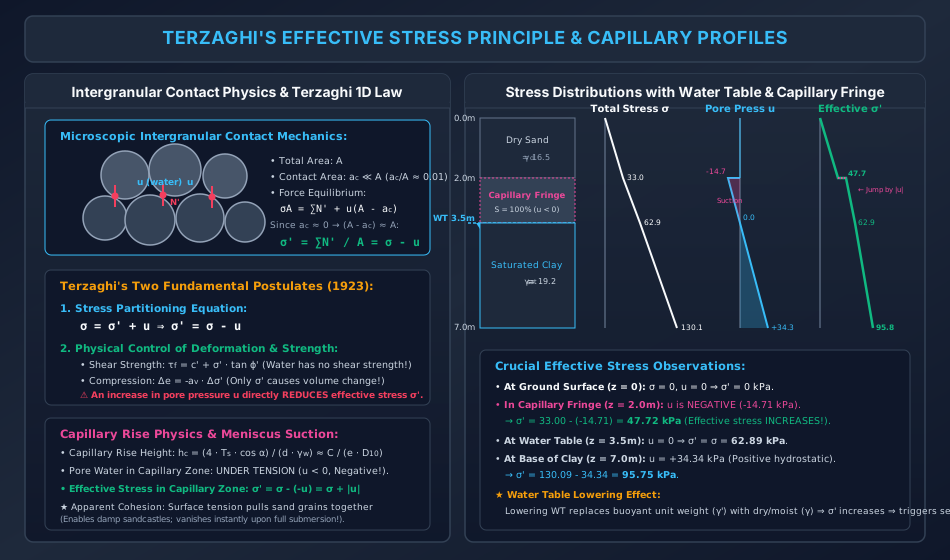
Consider a wavy microscopic section passing through a saturated soil mass of gross cross-sectional area . The cutting plane passes through the mineral grain contact points (total mineral contact area ) and the surrounding pore water (water area ).
             Total Normal Force = P = sigma * A
                         | | | |
                         v v v v
      [Grain 1]       [Grain 2]       [Grain 3]
          \               |               /
           *Contact       *Contact        *Contact
          /               |               \
      [Grain 4]       [Grain 5]       [Grain 6]
          ~~~~~~~~~~~~~~~~~~~~~~~~~~~~~~~~~
             Pore Water Pressure = u
Static Normal Force Equilibrium:
The total external normal force must be balanced by the sum of normal contact forces across grain contacts () and the hydrostatic pore water pressure acting on the pore fluid area:
Dividing both sides by the gross area :
Where:
- is the contact area ratio.
- Microscopic measurements and Hertzian contact mechanics show that even under enormous stresses (up to several MPa), the mineral contact area is minuscule:
- Setting the contact area ratio as a negligible quantity:
Therefore:
Defining the intergranular effective stress as :
4. Visual Master Diagram: Terzaghi's Principle & Capillary Profiles
The following architectural diagram illustrates the microscopic intergranular contact mechanics, Terzaghi's stress partitioning law, and the complete vertical stress distribution across a multi-layered profile featuring a dry sand stratum, a capillary fringe with negative pore water pressure (suction), and a saturated subsoil below the regional phreatic surface.
5. Capillary Phenomenon in Soils & Meniscus Suction
Water is held in the pores of unsaturated soils above the regional water table by the physical mechanism of surface tension along curved air-water menisci, forming what is known as the capillary fringe.
5.1 Capillary Rise Height Formulation
Modeling the interconnected void channels as a bundle of irregular vertical capillary tubes of equivalent diameter : The upward vertical component of the surface tension force acting around the perimeter of the meniscus balances the downward gravitational weight of the suspended water column of height :
Solving explicitly for the capillary rise height :
Where:
- is the surface tension of water ( at ).
- is the contact angle between water and mineral grain surfaces ( for clean quartz sand, hence ).
- is the effective pore diameter, which relates empirically to void ratio and effective grain size ().
Empirical Capillary Rise Formula (Hazen):
Where is an empirical constant ranging between and .
+------------------------------------+------------------------------------+
| SOIL TYPE                          | TYPICAL CAPILLARY RISE HEIGHT (hc) |
+------------------------------------+------------------------------------+
| Coarse Gravel                      | Practically zero (< 1 cm)          |
| Coarse Sand                        | 2 cm to 15 cm                      |
| Medium Sand                        | 15 cm to 35 cm                     |
| Fine Sand                          | 35 cm to 1.0 m                     |
| Silt                               | 1.0 m to 3.0 m (up to 10 m)        |
| Clay                               | Greater than 10 m (theoretically   |
|                                    | up to 30 m, limited by cavitation) |
+------------------------------------+------------------------------------+
5.2 Negative Pore Water Pressure (Matrix Suction) & Apparent Cohesion
In the capillary fringe above the phreatic surface:
- The water is in a state of hydrodynamic tension (suction).
- The pore water pressure is strictly negative:
- At the top of the capillary fringe ():
- Substituting negative pore pressure into Terzaghi's effective stress law:
The Apparent Cohesion Phenomenon: The tensile surface tension of the curved water menisci pulls adjacent soil grains tightly together. This internal suction force creates an apparent cohesion () in clean sands, allowing vertical trench cuts or children to sculpt damp sandcastles. However, if the sand is fully submerged under water ( hydrostatic) or thoroughly baked bone-dry (), the menisci disappear and the apparent cohesion vanishes instantly, causing immediate slope collapse.
6. Stress Profiles with Depth: Systematic Computational Rules
When computing vertical stresses at any depth :
Rule 1: Total Normal Stress ()
Total stress is the cumulative gravitational weight of all overlying material (soil solids + water + surface surcharges) per unit area:
- Use dry unit weight for bone-dry layers above capillary fringe.
- Use total/moist unit weight for partially saturated layers.
- Use saturated unit weight for submerged layers and fully saturated capillary zones ().
Rule 2: Pore Water Pressure ()
- At the regional phreatic surface (Water Table): .
- Below the Water Table (under static hydrostatic conditions):
- In the capillary fringe above the Water Table:
- Above the capillary fringe (dry soil): .
Rule 3: Effective Normal Stress ()
Always evaluate directly via Terzaghi's law:
Rule 4: Effect of Water Table Movement
- Water Table Lowering: When the water table is lowered (e.g., due to dewatering or seasonal drought), buoyant unit weight () is replaced by moist/dry unit weight (). Since , effective stress increases, causing compressive strain and ground subsidence.
- Water Table Rising: When the water table rises towards the surface, soil solids become buoyant (), decreasing effective stress by , significantly reducing soil bearing capacity and slope stability.
7. Visual Master Diagram: Hydrodynamic Seepage Forces & Quicksand
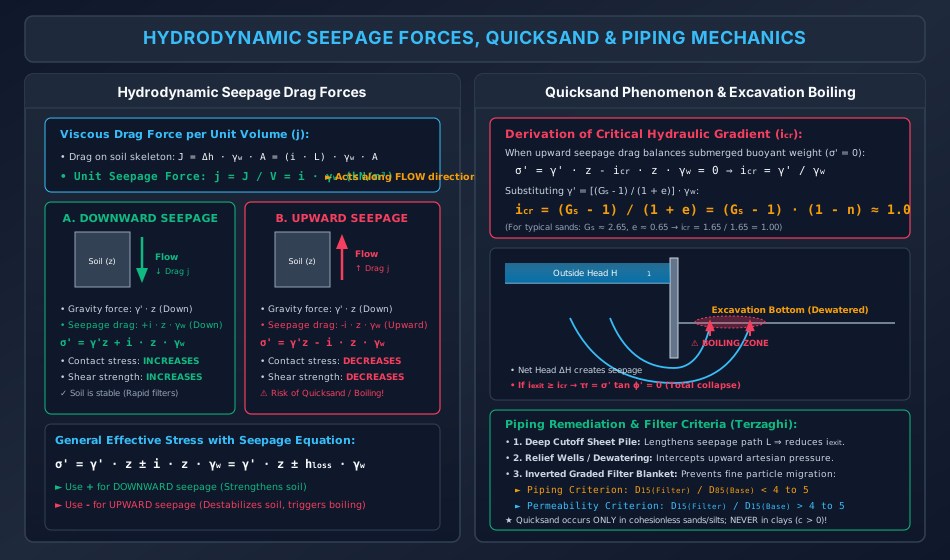
The following architectural diagram illustrates the generation of viscous seepage drag, the directional contrast between downward and upward seepage, the mechanics of boiling in sheet pile cofferdams, and Terzaghi's protective inverted filter design criteria.
8. Hydrodynamic Seepage Forces & Directional Mechanics
When water percolates through the interconnected pore channels of a soil mass under a hydraulic gradient , viscous shearing resistance exerts a frictional drag force on the mineral grains in the direction of flow. This drag force is termed the seepage force.
8.1 Analytical Derivation of Seepage Force per Unit Volume ()
Consider a cylindrical soil column of length and cross-sectional area across which a total hydraulic head loss occurs: The net hydrostatic pressure force driving the seepage is:
Dividing by the total volume of the soil element :
Where:
- is the seepage force per unit volume ().
- acts as a body force (like gravity) acting strictly parallel to the streamlines in the direction of flow.
8.2 Effective Stress Under Downward Seepage
When water seeps vertically downward through a soil layer:
- The seepage drag force acts downwards, reinforcing the gravitational submerged unit weight .
- At depth :
- Engineering Consequence: Downward seepage increases effective stress, enhances grain interlocking, increases shear strength, and compacts the bed. This principle is utilized in rapid gravity water treatment filters.
8.3 Effective Stress Under Upward Seepage
When water seeps vertically upward against gravity:
- The seepage drag force acts upwards, directly opposing and counteracting the submerged gravitational weight .
- At depth :
- Engineering Consequence: Upward seepage decreases effective stress, reduces intergranular contact forces, and diminishes shear strength.
9. Quicksand Phenomenon & Critical Hydraulic Gradient ()
If the upward seepage gradient is progressively increased, a critical threshold is reached where the upward hydrodynamic drag force precisely balances the downward submerged buoyant weight of the soil particles:
Dividing by :
Recalling that submerged unit weight is :
9.1 The Quicksand Condition
When :
- Effective normal stress drops to zero: .
- In a cohesionless soil ():
- The soil loses all internal shear resistance and bearing capacity. The sand particles become suspended in the upward water stream, behaving like a dense, viscous liquid. Any heavy object placed on the surface sinks rapidly under its own weight. This phenomenon is known as quicksand, boiling, or sand boils.
Crucial Exam Rule: Quicksand is NOT a Type of Soil! Quicksand is a hydraulic condition (a state of hydrodynamic equilibrium where ). It occurs only when water flows upward through loose, cohesionless fine sands and non-plastic coarse silts.
- Why Quicksand CANNOT Occur in Clays: In cohesive soils, true cohesion provides substantial shear strength even when effective normal stress is zero (). In clays, excess upward artesian pressure causes heave or blowouts of large intact blocks, but not boiling.
- Why Quicksand Rare in Coarse Gravels: Coarse gravels possess very high permeability; creating an exit gradient of requires an immense discharge volume that natural aquifers rarely sustain.
9.2 Typical Numerical Value of
For common quartz sands:
- Specific gravity
- Void ratio
As a golden rule of thumb for preliminary civil engineering calculations, .
10. Piping Failure & Protective Inverted Filter Design
10.1 Mechanism of Piping Failure
Piping is a catastrophic retrogressive failure mode:
- Upward seepage concentration at the downstream exit face of a dam or sheet pile excavation exceeds .
- Surface sand grains boil and are carried away by discharging water, forming an initial small cavity or "boil".
- Removal of soil concentrates flow lines toward the cavity, steepening the localized hydraulic gradient.
- Erosion propagates upstream along a preferential tubular flow path ("pipe") beneath the structure.
- The pipe reaches the reservoir, triggering instantaneous structural undermining and catastrophic dam collapse.
10.2 Terzaghi's Inverted Graded Filter Criteria
To prevent piping while allowing free drainage of seepage water, an inverted protective filter (coarser layers placed over finer soil) must satisfy Terzaghi's two empirical criteria:
+------------------------------------+---------------------------------------------------------------+
| CRITERION                          | MATHEMATICAL SPECIFICATION & ENGINEERING PURPOSE             |
+------------------------------------+---------------------------------------------------------------+
| 1. Piping / Retention Criterion    | D_15(Filter) / D_85(Base Soil) < 4 to 5                       |
| (Prevents Base Soil Migration)     | Pores of the filter must be small enough to block base grains.|
+------------------------------------+---------------------------------------------------------------+
| 2. Permeability / Drainage Criterion| D_15(Filter) / D_15(Base Soil) > 4 to 5                       |
| (Ensures Free Discharge)           | Filter must be 20x to 25x more permeable than the base soil   |
|                                    | so pore pressures dissipate without building head.            |
+------------------------------------+---------------------------------------------------------------+
| 3. Uniformity Criterion            | Coefficient of uniformity C_u(Filter) <= 20                   |
| (Prevents Filter Segregation)      | Prevents segregation during placement.                        |
+------------------------------------+---------------------------------------------------------------+
11. Solved Numerical Problems (Step-by-Step, Pre-Calculated)
Problem 1: Effective Stress Profile with Water Table and Full Capillary Fringe (GATE CE / UPSC ESE)
A natural subsoil profile consists of the following strata from ground level:
- 0.0 m to 2.0 m: Dry sand with dry unit weight .
- 2.0 m to 3.5 m: Sand layer saturated by capillary rise () above the regional phreatic surface. Specific gravity , void ratio .
- At 3.5 m depth: Regional phreatic surface (Water Table).
- 3.5 m to 7.0 m: Saturated clay layer with .
Calculate the total stress (), pore water pressure (), and effective stress () at:
- Ground surface ().
- Depth (top of the capillary fringe, just inside the fringe).
- Depth (at the water table).
- Depth (base of the clay layer).
Solution:
Step 1: Compute unit weights
- For dry sand (): .
- For capillary sand (): , , :
- For clay (): .
Step 2: Stress computation at (Ground Surface)
- Total stress:
- Pore water pressure:
- Effective stress:
Step 3: Stress computation at (Top of Capillary Fringe)
- Total stress:
- Pore water pressure: Point is above the water table with saturation:
- Effective stress:
(Note: If calculated just above in the dry sand where , . The capillary suction causes an instantaneous step increase of in effective stress!).
Step 4: Stress computation at (Water Table)
- Total stress:
- Pore water pressure (at the phreatic surface):
- Effective stress:
Step 5: Stress computation at (Base of Clay Layer)
- Total stress:
- Pore water pressure ( depth below water table):
- Effective stress:
Problem 2: Upward Seepage & Quicksand Safety in Cofferdam Excavation (UPSC ESE / GATE CE)
A deep excavation in a cohesionless sand stratum (, ) is dewatered to a depth of above an artesian gravel aquifer. The thickness of the remaining sand plug at the bottom of the excavation is . Piezometer observations indicate that the artesian water head in the gravel causes a net upward head loss of across the sand plug.
Determine:
- The submerged unit weight () of the sand.
- The critical hydraulic gradient () for quicksand.
- The actual upward hydraulic gradient () and the effective stress () at the base of the sand layer ().
- The Factor of Safety against boiling.
- The critical artesian head loss () that would trigger total liquefaction / quicksand boiling.
Solution:
Step 1: Submerged Unit Weight & Critical Gradient
Step 2: Actual Upward Gradient & Effective Stress at Base
Under upward seepage:
Step 3: Factor of Safety Against Boiling
Step 4: Critical Artesian Head Causing Boiling Quicksand occurs when :
Problem 3: Downward Seepage in Filter Tank with Surcharge (SSC JE / State AE)
A laboratory sand filter tank contains a sand layer of thickness (, ). Water is ponded over the sand to a depth of . A uniform surcharge load of is applied at the water surface. Water discharges freely from the base of the tank under downward seepage, producing a total head loss of across the sand bed.
Compute the total stress (), pore water pressure (), and effective stress () at the base of the sand layer ():
- Under static condition (zero seepage).
- Under active downward seepage.
- State the net increase in effective stress caused by the downward seepage.
Solution:
Step 1: Soil parameters
Step 2: Static Condition (Zero Seepage)
- Total stress at base:
- Hydrostatic pore water pressure at base:
- Effective stress at base: (Check: )
Step 3: Downward Seepage Condition
- Total stress remains unchanged: .
- Because downward seepage occurs, the total head at the base decreases by . The pore water pressure at the base is reduced by :
- Effective stress at base: (Check: )
Step 4: Net Increase in Effective Stress
12. Comparative Engineering Analysis & Multi-Exam Question Patterns
+------------------------------------+-------------------------------------------------------------------------------------------------------------------+
| EXAM LEVEL                         | HIGHEST YIELD TOPICS & TYPICAL QUESTION PATTERNS                                                                 |
+------------------------------------+-------------------------------------------------------------------------------------------------------------------+
| GATE CE                            | - Multi-layered vertical effective stress profiles with capillary rise suction ($u = -h \gamma_w$).              |
|                                    | - Upward seepage problem in cofferdam excavations ($h_{\text{crit}} = i_{\text{cr}} H$).                         |
|                                    | - Downward seepage in filter tanks and effective stress enhancement ($\sigma' = \gamma' z + \Delta h \gamma_w$). |
|                                    | - Critical hydraulic gradient with void ratio and porosity formulations.                                         |
+------------------------------------+-------------------------------------------------------------------------------------------------------------------+
| UPSC ESE                           | - Microscopic derivation of Terzaghi's 1D effective stress principle from force equilibrium ($a_c / A \to 0$).    |
|                                    | - Analytical proof that quicksand cannot occur in cohesive clays ($c' > 0$).                                     |
|                                    | - Terzaghi's protective filter design criteria ($D_{15F}/D_{85B}$ and $D_{15F}/D_{15B}$).                         |
|                                    | - Capillary rise height derivation from surface tension force equilibrium.                                       |
+------------------------------------+-------------------------------------------------------------------------------------------------------------------+
| SSC JE / RRB JE                    | - Fundamental formula: $\sigma' = \sigma - u$.                                                                   |
|                                    | - Critical gradient formula: $i_{\text{cr}} = (G_s - 1) / (1 + e) \approx 1.0$.                                  |
|                                    | - Quicksand definition: hydraulic condition, NOT a soil type; occurs in fine sand / coarse silt.                  |
|                                    | - Effect of water table rising: effective stress decreases → bearing capacity drops.                       |
+------------------------------------+-------------------------------------------------------------------------------------------------------------------+
| State AE / JE                      | - Apparent cohesion mechanism in damp sands (meniscus surface tension suction).                                  |
|                                    | - Unit seepage force formula: $j = i \cdot \gamma_w$ ($\text{kN/m}^3$).                                          |
|                                    | - Sign convention for seepage stress modification ($+$ for downward, $-$ for upward).                            |
+------------------------------------+-------------------------------------------------------------------------------------------------------------------+
13. Common Misconceptions, Pitfalls & Pro-Tips
Critical Traps to Avoid in Competitive Exams
- The Capillary Pore Pressure Sign Trap: In the capillary zone above the water table, pore pressure is negative (). When applying , subtracting a negative number yields an addition: . Many students mistakenly subtract , incorrectly lowering the effective stress instead of raising it!
- Quicksand Misconception: Quicksand is not a special type of soil; it is a hydrodynamic flow state. Quicksand cannot occur under static water, nor can it occur under downward flow. It requires upward flow satisfying .
- Ponded Water Over Soil Surface: If water is ponded to height above a submerged soil ground surface, adding more water depth increases total stress by and increases pore water pressure by the exact same amount . Therefore, effective stress at any depth in the underlying soil remains completely unchanged!
- Critical Gradient with Porosity: . In exams, questions frequently supply porosity instead of void ratio . Using in place of or vice versa causes instantaneous failure.
- Seepage Force Sign Rule:
- Downward Seepage: Seepage drag acts with gravity .
- Upward Seepage: Seepage drag acts against gravity .
14. Key Reference Formulas & Summary Table
+-------------------------------------------------------+-------------------------------------------------------------+
| PARAMETER / FORMULA                                   | MATHEMATICAL EXPRESSION                                     |
+-------------------------------------------------------+-------------------------------------------------------------+
| Terzaghi's Effective Stress Principle                 | sigma' = sigma - u                                          |
+-------------------------------------------------------+-------------------------------------------------------------+
| Mohr-Coulomb Effective Shear Strength                 | tau_f = c' + sigma' * tan(phi')                             |
+-------------------------------------------------------+-------------------------------------------------------------+
| Capillary Rise Height                                 | h_c = (4 * T_s * cos(alpha)) / (d * gamma_w)                |
+-------------------------------------------------------+-------------------------------------------------------------+
| Hazen Capillary Rise Empirical Formula                | h_c = C / (e * D_10)                                        |
+-------------------------------------------------------+-------------------------------------------------------------+
| Effective Stress in Capillary Fringe                  | sigma' = sigma - (-|u|) = sigma + |u|                       |
+-------------------------------------------------------+-------------------------------------------------------------+
| Unit Seepage Force                                    | j = i * gamma_w   (kN/m^3)                                  |
+-------------------------------------------------------+-------------------------------------------------------------+
| Total Seepage Force on Volume V                       | J = j * V = i * gamma_w * V = Delta_h * gamma_w * A         |
+-------------------------------------------------------+-------------------------------------------------------------+
| Effective Stress with Downward Seepage                | sigma' = gamma' * z + i * z * gamma_w                       |
+-------------------------------------------------------+-------------------------------------------------------------+
| Effective Stress with Upward Seepage                  | sigma' = gamma' * z - i * z * gamma_w                       |
+-------------------------------------------------------+-------------------------------------------------------------+
| Critical Hydraulic Gradient (Quicksand)               | i_cr = gamma' / gamma_w = (G_s - 1) / (1 + e) = (G_s - 1)(1 - n) |
+-------------------------------------------------------+-------------------------------------------------------------+
| Factor of Safety Against Boiling                      | FOS = i_cr / i_upward                                       |
+-------------------------------------------------------+-------------------------------------------------------------+
| Critical Head Causing Boiling                         | h_cr = i_cr * H_soil                                        |
+-------------------------------------------------------+-------------------------------------------------------------+
| Terzaghi Filter Retention (Piping) Criterion          | D_15(Filter) / D_85(Base) < 4 to 5                          |
+-------------------------------------------------------+-------------------------------------------------------------+
| Terzaghi Filter Permeability Criterion                | D_15(Filter) / D_15(Base) > 4 to 5                          |
+-------------------------------------------------------+-------------------------------------------------------------+
Authored with mathematical rigor, IS code precision, and multi-exam alignment for the Civil Engineering Academic Knowledge Repository.