Traditional Building Materials: Bricks, Stones, Timber & Finishes
In this chapter (1 topics)
On this page
- 1. Topic Title & Authoritative References
- 2. Prerequisites & Learning Objectives
- Prerequisites
- Learning Objectives
- 3. Brick Earth Chemistry, Harmful Ingredients & Manufacturing Thermochemistry
- 3.1 Chemical Constitution of Ideal Brick Earth
- 3.2 Harmful Ingredients in Brick Earth
- 3.3 Manufacturing Process of Burnt Clay Bricks
- 3.4 Kiln Technology: Clamp Kiln vs Continuous Kilns
- 4. Engineering Classification, Testing Protocols & Codal Requirements (IS 1077 & IS 3495)
- 4.1 Standard Modular Brick Geometry
- 4.2 Standard Testing Protocols per IS 3495
- 4.3 Classification of Bricks per IS 1077:1992
- 5. Masonry Bonds & Structural Detailing
- 5.1 Masonry Terminology & Closers
- 5.2 Comparative Analysis of Masonry Bonds
- 6. Building Stones: Petrology, Quarrying & Codal Testing
- 6.1 Engineering Classifications of Building Stones
- 6.2 Mohs Scale of Mineral Hardness
- 6.3 Quarrying, Dressing & Blasting Mechanics
- 6.4 Standard Laboratory Tests on Stones per IS 1121 & IS 1124
- 7. Timber Anatomy, Moisture Physics & Fiber Saturation Point (FSP)
- 7.1 Macro-Anatomy of Exogenous Tree Cross-Section
- 7.2 Moisture Physics in Wood: Free Water vs Bound Water & FSP
- 7.3 Quantitative Anisotropy of Shrinkage
- 8. Seasoning, Defects, Fungal Decay, Preservation & Engineered Wood
- 8.1 Seasoning of Timber (IS 1141)
- 8.2 Defects in Timber
- 8.3 Fungal Decay & Biological Pathogens
- 8.4 Chemical Preservation of Timber (IS 401)
- 8.5 Engineered Wood Products (IS 303, IS 848)
- 9. Paints, Varnishes, Distempers & Finishes
- 9.1 Formulations of Oil Paints
- 9.2 Varnishes, Distempers & DPC
- 9.3 Diagnostic Failure Modes in Paint Films
- 10. Step-by-Step Analytical Derivations & Quantitative Formulations
- 10.1 Mathematical Formulation of Moisture Content & Anisotropic Shrinkage in Timber
- 10.2 Structural Masonry Design per IS 1905:1987
- 11. Solved Numerical Examples (Pre-Calculated & Python-Verified)
- Problem 1: Compressive Strength, Water Absorption & IS 1077 Classification
- Problem 2: Timber Physics, Equilibrium Moisture & Anisotropic Shrinkage
- Problem 3: Masonry Load-Bearing Capacity & Stress Reduction (IS 1905)
- 12. Common Misconceptions, Pitfalls & Exam Traps
- 13. Practice Problems (Curated for Competitive Examinations)
- Level 1: Objective & Conceptual (SSC JE / RRB JE / State AE)
- Level 2: Analytical & Multi-Step (GATE CE / UPSC ESE)
- 14. Quick Revision Summary & Memory Hooks
- Core Numerical Constants & Codal Rules
1. Topic Title & Authoritative References
Title: Traditional Building Materials: Clay Brick Manufacturing, Thermochemistry, Classification & Testing (IS 1077, IS 3495); Masonry Bonds & Structural Mechanics (IS 1905, IS 2212); Building Stones Geology, Quarrying & Petrology (IS 1121, IS 1124); Timber Anatomy, Moisture Physics, Seasoning, Defects & Chemical Preservation (IS 399, IS 401, IS 1141, IS 1708); and Surface Coatings (Paints, Varnishes & Distempers).
Primary Standards & Authoritative Specifications:
- IS 1077:1992: Common Burnt Clay Building Bricks — Specification (Fifth Revision).
- IS 3495 (Parts 1 to 4):2019: Methods of Tests of Burnt Clay Building Bricks (Part 1: Compressive Strength, Part 2: Water Absorption, Part 3: Efflorescence, Part 4: Warpage).
- IS 2117:1991: Guide for Manufacture of Handmade Common Burnt Clay Building Bricks.
- IS 2212:1991: Code of Practice for Brickwork.
- IS 1905:1987: Code of Practice for Structural Use of Unreinforced Masonry (Third Revision).
- IS 1121 (Parts 1 to 4):2013: Methods of Test for Determination of Strength Properties of Natural Building Stones.
- IS 1124:1974: Method of Test for Determination of Water Absorption, Apparent Specific Gravity and Porosity of Natural Building Stones.
- IS 399:1963: Classification of Commercial Timbers and Their Zonal Distribution.
- IS 1141:1993: Seasoning of Timber — Code of Practice.
- IS 401:2001: Preservation of Timber — Code of Practice.
- IS 1708 (Parts 1 to 18):1986: Methods of Testing of Small Clear Specimens of Timber.
- IS 303:1989: Plywood for General Purposes — Specification.
2. Prerequisites & Learning Objectives
Prerequisites
- Basic chemistry: silica, alumina, ferric oxide, lime fluxing reactions, and high-temperature ceramic vitrification.
- Solid mechanics: uniaxial compression, shear keys, slenderness ratio, load eccentricity, and elastic buckling.
- Material physics: capillary absorption, hygroscopic moisture equilibria, anisotropic cellular shrinkage, and fungal biodegradation.
Learning Objectives
- Formulate the chemical constitution of ideal brick earth (Silica , Alumina , Lime , Iron Oxide , Magnesia ) and diagnose the deleterious effects of excess ingredients (lime popping, alkalis causing efflorescence, iron pyrites, pebbles).
- Trace the stages of brick manufacturing (unsoiling, digging, weathering, blending, tempering in pug mills, molding, drying) and the thermochemical burning zones in Bull's trench versus Hoffman's kilns (dehydration , oxidation , vitrification ).
- Master standard brick geometries (, frog ), masonry bonds (English bond, Flemish bond, Quoin closers), and testing protocols per IS 3495 (compressive strength, 24-hr cold water absorption, efflorescence ratings).
- Classify building stones geologically (Igneous, Sedimentary, Metamorphic), chemically (Siliceous, Argillaceous, Calcareous), and physically (Stratified, Unstratified, Foliated), correlating mineral hardness on the Mohs scale () with quarrying and laboratory acceptance criteria.
- Analyze the microscopic and macro-anatomical cross-section of exogenous wood trunks (pith, heartwood, sapwood, cambium, inner/outer bark, medullary rays, annual rings).
- Formulate timber moisture physics: distinguish free water in lumens from bound water in cell walls, locate the Fiber Saturation Point (), and calculate anisotropic dimensional shrinkage ().
- Identify natural defects (knots, star/heart/cup/ring shakes), conversion/seasoning warps (bow, cup, twist), fungal pathogens (Merulius lacrymans dry rot vs wet rot), and chemical preservation treatments (ASCU formula , creosoting, Sir Abel's fire retardation).
- Dissect surface finishes: vehicles/drying oils (linseed oil), bases (white lead, zinc oxide, titanium dioxide), solvents/thinners (turpentine), and identify film failure mechanisms (alligatoring, blistering, chalking, blooming, flaking).
3. Brick Earth Chemistry, Harmful Ingredients & Manufacturing Thermochemistry
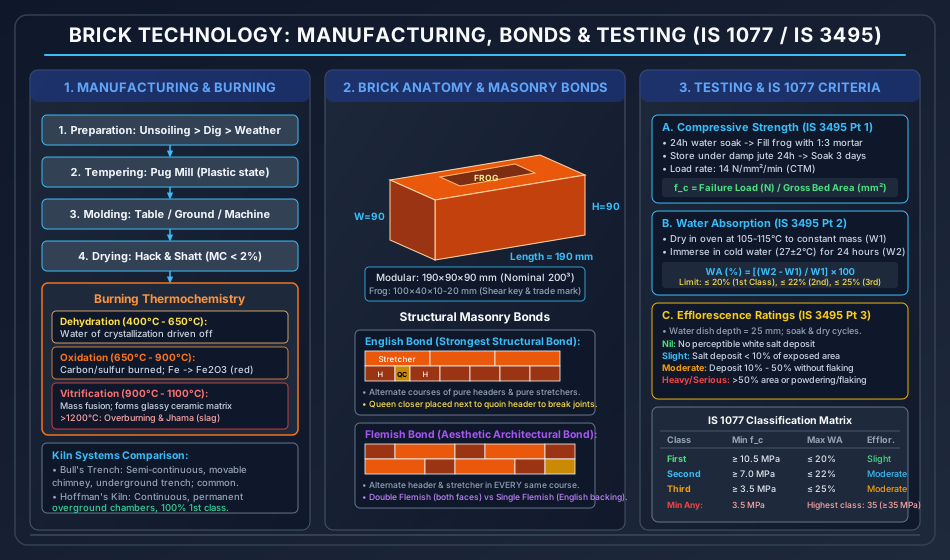
3.1 Chemical Constitution of Ideal Brick Earth
Brick earth is an alluvial or sedimentary silty clay consisting primarily of silica and alumina, chemically balanced by fluxes:
- Silica ():
- Role: Exists either in chemical combination with alumina as clay silicate, or as free uncombined sand particles. It preserves the shape and sharp edges of the brick, prevents shrinkage, cracking, and warping during drying and firing, and imparts uniform durability.
- Excess Danger: Excess free silica destroys cohesion between particles, making bricks brittle, crumbly, and low in tensile and compressive strength.
- Alumina ():
- Role: Forms the plastic constituent of brick earth (hydrated aluminosilicate). It imparts plasticity to the mass when mixed with water, enabling easy molding without rupture.
- Excess Danger: Excess alumina produces extreme plasticity, causing the green bricks to warp, twist, and undergo severe volumetric shrinkage and cracking during drying and kiln burning.
- Lime (): (Finely Divided Powder)
- Role: Acts as a chemical flux at high burning temperatures (). It causes the silica grains to melt slightly and fuse together with alumina, binding the ceramic matrix. It also prevents excessive shrinkage of alumina.
- Excess Danger: Excess lime causes premature vitrification and melting, leading to loss of brick shape (slumping). If present in lumps or nodules (kankar nodules), it calcines to quicklime () during burning; upon exposure to atmospheric moisture, quicklime slakes to calcium hydroxide (), expanding volumetrically by and causing the brick to split, spall, and pop (lime blowing / lime popping).
- Iron Oxide ():
- Role: Acts as a secondary flux, lowering the fusion point of silica. When burnt in an oxidizing kiln atmosphere, it oxidizes to ferric oxide, imparting the characteristic red/cherry colour to bricks.
- Deficiency & Excess: If , bricks turn yellowish or pale; if excess (), or burnt in a reducing atmosphere (deficiency of oxygen), it forms ferrous oxide (), rendering the brick dark blue, purple, or black.
- Magnesia ():
- Role: Imparts a slight yellowish tint to the brick and reduces shrinkage.
- Excess Danger: Excess magnesia causes bricks to decay, rot, and crumble over time.
3.2 Harmful Ingredients in Brick Earth
- Lime Nodules / Kankar: Induces explosive lime popping upon slaking.
- Alkalis (): If present in excess, they act as fluxes causing melting; upon exposure in masonry, soluble alkali sulfates () leach out with water and crystallize on the surface as disfiguring white powdery patches (efflorescence).
- Iron Pyrites (): Oxidizes and decomposes during burning, splitting the brick and leaving black, crystallized discoloration patches.
- Pebbles, Gravel & Roots: Produce localized stress concentrations, prevent homogeneous tempering, and lead to jagged fractures under load.
- Organic & Vegetative Matter: Burns off completely during kiln firing, leaving porous voids and hollow air channels, which drastically lowers the compressive strength and sharply increases water absorption.
3.3 Manufacturing Process of Burnt Clay Bricks
- Preparation of Clay:
- Unsoiling: Topsoil () stripped off to remove roots and organic debris.
- Digging & Weathering: Earth excavated and heaped in stacks exposed to weather (rain, sun, frost) for weeks/months to improve plasticity and homogeneity.
- Blending: Sand, fluxes, or water added in precise proportions.
- Tempering: Kneading the moistened clay into a homogeneous plastic mass. On commercial scales, tempering is carried out continuously in a conical iron Pug Mill using revolving helical blades.
- Molding:
- Hand Molding: Ground molding (stock boards, pallets) or Table molding (for sharper edges). Molds are slightly oversized () to compensate for drying and burning shrinkage. Molds lubricated with sand (sand-molded bricks) or dipped in water (slop-molded bricks).
- Machine Molding: Plastic clay machine (wire-cut bricks extruded through rectangular die and sliced) or Dry press machine (semi-dry clay compacted under high hydraulic pressure).
- Drying:
- Bricks stacked on edge in pairs (hacks) on elevated sand beds (shatts) for under natural shade until moisture drops to . Direct sunlight causes fast non-uniform drying, leading to cracking.
- Burning & Thermochemistry:
- Dehydration / Water-Smoking Zone (): Hygroscopic and chemically bound water of crystallization in hydrated aluminosilicates () is driven off vaporously.
- Oxidation Zone (): Carbonaceous and sulfurous impurities burn off. Iron oxidizes fully to ferric oxide (), developing red color.
- Vitrification Zone (): Lime, magnesia, and iron oxides react with free silica to form low-melting liquid silicates. This liquid phase fills intergranular pores; upon cooling, it solidifies into a dense, hard, glassy ceramic matrix.
- Overburning (): Excessive fusion collapses brick geometry into an irregular, twisted, vitrified mass called Jhama brick (unfit for masonry; crushed for aggregate/surkhi).
3.4 Kiln Technology: Clamp Kiln vs Continuous Kilns
- Clamp Kiln (Pajawa): Temporary, intermittent stack; alternative layers of raw bricks and local fuel (coal dust, cow dung, husks). Uncontrolled firing, thermal efficiency , yields only first-class bricks, underburnt (pila), overburnt (jhama).
- Bull's Trench Kiln (BTK): Semi-continuous or continuous, oval/circular trench excavated below ground level with movable sheet-iron chimneys. Bricks arranged in sections: preheating, firing, cooling, unloading. Most widely used in South Asia.
- Hoffman's Kiln: Permanent circular or elliptical brick masonry structure built entirely above ground with a permanent central chimney and interconnected chambers. Highly uniform heat recovery, fuel economy, and yields first-class bricks.
4. Engineering Classification, Testing Protocols & Codal Requirements (IS 1077 & IS 3495)
4.1 Standard Modular Brick Geometry
- Standard Modular Size: .
- Nominal Size (with mortar joint): .
- Non-Modular / Traditional Size: Commonly ().
- Frog: An indentation formed on the top bed face of hand-molded bricks.
- Standard Dimensions: .
- Purpose: Serves as a mechanical shear key (locking mortar joint between courses) and displays manufacturer trademark. Wire-cut and pressed bricks typically lack frogs or have perforations.
4.2 Standard Testing Protocols per IS 3495
                              IS 3495 TESTING SUITE
         ┌──────────────────────────────┼──────────────────────────────┐
         │                              │                              │
  IS 3495 (Part 1)               IS 3495 (Part 2)               IS 3495 (Part 3)
Compressive Strength             Water Absorption                 Efflorescence
• Immerse in water 24h           • Oven dry at 105-115°C (W1)   • Stand vertically in
• Fill frog with 1:3 mortar      • Immerse cold water 24h (W2)    25 mm distilled water
• Damp jute 24h, soak 3 days     • WA = (W2 - W1)/W1 * 100%     • Dry -> Repeat 2nd cycle
• Rate: 14 N/mm²/min (CTM)       • 1st Class: <= 20%            • Nil, Slight (<10%),
• Class: 3.5 to 35 MPa           • 2nd: <= 22%, 3rd: <= 25%       Mod (10-50%), Heavy
1. Compressive Strength Test (IS 3495 Part 1)
- Apparatus & Preparation:
- Five representative bricks immersed in water at for .
- Frogs and bed depressions filled flush with cement-sand mortar ( down quartz sand).
- Stored under damp jute sacks for , followed by full immersion in clean water for to cure the mortar.
- Tested flatwise in a Compression Testing Machine (CTM) between plywood packing sheets at a loading rate of () until failure.
- Formula: where is maximum crushing load (), and is gross area of the bed face (). Average of 5 specimens reported.
2. Water Absorption Test (IS 3495 Part 2)
- 24-Hour Cold Water Immersion:
- Specimen dried in a ventilated oven at to constant weight ().
- Immersed completely in clean water at for .
- Surface wiped dry with a damp cloth and weighed within 3 minutes ().
- 5-Hour Boiling Water Immersion:
- Saturation Coefficient (C/B Ratio): Diagnostic Criterion: guarantees high resistance to freeze-thaw spalling, ensuring sufficient unfilled micropore space for expanding ice crystals.
3. Efflorescence Test (IS 3495 Part 3)
- Specimens placed on end in a flat-bottom glass dish containing distilled water to a depth of in a well-ventilated room at .
- Water absorbed and allowed to evaporate completely. A second charge of water added and allowed to evaporate.
- Visual rating per IS 3495:
- Nil: No perceptible deposit of efflorescence.
- Slight: Deposit covers of exposed surface area, with no flaking.
- Moderate: Heavier deposit covering of surface area, with no surface powdering or flaking.
- Heavy: Deposit covering of surface area, but no powdering/flaking.
- Serious: Heavy deposit accompanied by pitting, flaking, or powdering of brick face (unacceptable).
4.3 Classification of Bricks per IS 1077:1992
Burnt clay bricks are classified on the basis of their minimum average compressive strength into 11 classes:
| Class Designation | Minimum Compressive Strength () | Max 24-hr Water Absorption () | Permissible Efflorescence Rating |
|---|---|---|---|
| Class 35 | Nil | ||
| Class 30 | Nil | ||
| Class 25 | Nil | ||
| Class 20 | Slight | ||
| Class 17.5 | Slight | ||
| Class 15 | Slight | ||
| Class 12.5 | Slight | ||
| Class 10 (First Class) | ( conventional) | Slight | |
| Class 7.5 (Second Class) | ( conventional) | Moderate | |
| Class 5.0 | Moderate | ||
| Class 3.5 (Third Class) | Moderate |
Codal Minimum: Under NO circumstances shall any brick used in structural masonry possess a compressive strength .
5. Masonry Bonds & Structural Detailing
5.1 Masonry Terminology & Closers
- Header: A brick laid with its length perpendicular to the face of the wall ( face visible).
- Stretcher: A brick laid with its length parallel to the wall face ( face visible).
- Course: A horizontal layer of bricks including mortar.
- Bed Joint: Horizontal mortar joint between courses.
- Vertical / Cross Joint (Perpend): Vertical joint perpendicular to the wall face.
- Quoin: The external corner of a wall ( angle).
- Closers (Cutting Units to Prevent Continuous Vertical Joints):
- Queen Closer (Half): A brick cut longitudinally into two equal halves (). Always placed adjacent to the quoin header in heading courses.
- Queen Closer (Quarter): A queen closer cut in half transversally ().
- King Closer: A brick cut triangularly by removing the corner between the center of one end and the center of one side ( on header face, on stretcher face). Used around window and door jambs.
- Bevelled Closer: One half of the width bevelled along the full length.
- Mitred Closer: One end cut splayed at .
- Bat: A brick cut across its width: Half bat (), Three-quarter bat ().
5.2 Comparative Analysis of Masonry Bonds
- English Bond:
- Arrangement: Alternate courses of pure headers and pure stretchers.
- Joint Staggering: A Queen Closer is inserted immediately after the quoin header in every header course to generate a quarter-brick lap () and break continuous vertical joints.
- Structural Performance: Strongest bond in brick masonry; provides superior transverse shear resistance and uninterrupted load distribution. Universally mandated for heavy load-bearing structural walls.
- Flemish Bond:
- Arrangement: Alternate headers and stretchers laid in the same course.
- Double Flemish Bond: Headers and stretchers show identical alternating patterns on both internal and external wall faces for walls brick thick ().
- Single Flemish Bond: Flemish bond on the exposed face, backed with English bond internally. Can only be constructed in walls of minimum thickness ().
- Performance: Architecturally aesthetically pleasing; however, possesses lower shear strength than English bond due to partially aligned internal perpends, and requires skilled labor.
- Header Bond: Entire wall composed of headers. Used for curved walling, footings, and corbels. Minimum thickness ().
- Stretcher Bond: Entire wall composed of stretchers. Only suitable for half-brick thick () non-load-bearing partition walls.
- Cavity Walls: Consists of an external leaf (), an air cavity (), and an internal leaf (), tied together with stainless steel wall ties. Prevents damp penetration, provides superior thermal insulation (-value reduction), and acoustic damping.
6. Building Stones: Petrology, Quarrying & Codal Testing
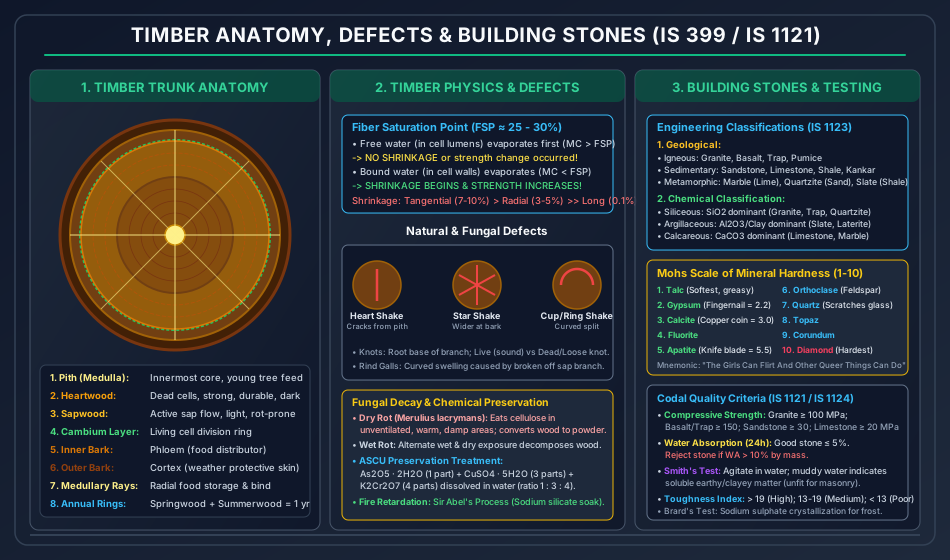
6.1 Engineering Classifications of Building Stones
1. Geological Classification
- Igneous Rocks: Formed by solidification and crystallization of molten magma/lava.
- Plutonic (deep-seated intrusive, slow cooling, coarse-grained holocrystalline): Granite, Syenite, Diorite, Gabbro.
- Hypabyssal (shallow intrusive, medium depth): Dolerite.
- Volcanic (extrusive, rapid cooling at surface, fine-grained/glassy): Basalt, Trap, Rhyolite, Pumice.
- Sedimentary Rocks: Formed by weathering, erosion, deposition, compaction, and cementation of pre-existing mineral fragments or organic precipitates.
- Clastic / Mechanically Formed: Sandstone, Shale, Conglomerate, Breccia.
- Chemical Precipitates: Limestone, Gypsum, Rock Salt.
- Organically Formed: Chalk, Lignite, Coral limestone.
- Metamorphic Rocks: Pre-existing igneous or sedimentary rocks altered by intense geological heat, directional pressure, and hydrothermal fluids.
- Granite Gneiss
- Sandstone Quartzite (Hardest, most durable building stone)
- Limestone Marble
- Shale Slate
- Basalt Schist
2. Chemical Classification
- Siliceous Rocks: Silica () forms the dominant constituent (). Chemically inert, durable, highly resistant to acidic industrial fumes and weathering. Examples: Granite, Quartzite, Basalt, Trap, Sandstone.
- Argillaceous Rocks: Alumina / Clay () forms the principal base. Dense, compact, but brittle; susceptible to cleavage splitting. Examples: Slate, Laterite, Kaolin.
- Calcareous Rocks: Calcium carbonate () forms the main component. Soluble in acidic rainwater (forms ); vulnerable to industrial sulfur fumes. Examples: Limestone, Marble.
3. Physical Classification
- Stratified Rocks: Distinct bedding planes along which the rock splits easily (Sandstone, Limestone, Shale).
- Unstratified Rocks: Monolithic crystalline structure with no bedding cleavage (Granite, Basalt, Trap).
- Foliated Rocks: Tendency to split in a definite parallel direction induced by metamorphic stress (Slate, Gneiss, Schist).
6.2 Mohs Scale of Mineral Hardness
Determined by the scratch resistance of ten standard minerals:
Field References:
- Fingernail hardness: (scratches Gypsum, not Calcite).
- Copper coin: (scratches Calcite).
- Knife blade / Window glass: (scratches Apatite, not Orthoclase).
- Steel file: .
- Quartz () scratches ordinary glass with ease.
6.3 Quarrying, Dressing & Blasting Mechanics
- Quarrying Methods: Digging/Excavating (soft stones), Wedging & Channeling (stratified stones: marble, limestone, sandstone along rift planes), Blasting with explosives (hard unstratified rocks: granite, basalt).
- Explosives for Blasting:
- Blasting Powder (Gunpowder): . Slow deflagrating propellant; splits stone along joints without shattering.
- Dynamite: Nitroglycerin () absorbed in kieselguhr (). High explosive; shatters rock into fragments.
- Ammonium Nitrate Fuel Oil (ANFO): fuel oil. Economical bulk explosive.
- Blasting Powder Factor ():
- Dressing of Stones: Shaping freshly quarried rock while it retains its natural quarry sap (moisture containing dissolved mineral salts). As quarry sap evaporates, dissolved salts crystallize, forming a hard protective exterior crust; dressing stone after drying is difficult and fractures the crust.
6.4 Standard Laboratory Tests on Stones per IS 1121 & IS 1124
- Compressive Strength Test (IS 1121 Part 1):
- Test specimens: Cubes ( or edge) or Cylinders (), smoothly ground.
- Immersed in water for prior to test.
- Tested in CTM with load applied perpendicular to natural quarry bed planes.
- Minimum Strengths: Basalt/Trap , Granite , Slate , Quartzite , Sandstone , Limestone , Laterite .
- Water Absorption Test (IS 1124):
- Dried at to constant mass (), immersed in water for ().
- Good building stones must have water absorption by mass. Stones with absorption are rejected.
- Smith's Test (Earthy / Clayey Matter):
- Freshly chipped stone pieces placed in a test tube of clean water and vigorously agitated.
- Muddy, turbid water reveals the presence of loose, soluble earthy, muddy, or clayey matter, indicating poor weathering resistance.
- Acid Test (Industrial Durability):
- Specimen immersed in a solution for .
- Sharp edges remaining intact indicates high silica content; rounded edges and loose powder indicate vulnerable calcium carbonate.
- Brard's Test (Frost Resistance):
- Specimen boiled in saturated sodium sulphate () solution, dried, and weighed over multiple cycles. Expanding salt crystallization simulates frost heaving in sub-zero climates.
7. Timber Anatomy, Moisture Physics & Fiber Saturation Point (FSP)
7.1 Macro-Anatomy of Exogenous Tree Cross-Section
Exogenous trees grow outwards by the addition of concentric annual rings beneath the bark (Gymnosperms/Conifers like Pine, Deodar, Fir = Softwoods; Dicotyledons like Teak, Sal, Sheesham = Hardwoods). An orthogonal transverse section reveals:
- Pith (Medulla):
- The innermost central core of the tree trunk ( diameter), consisting of cellular parenchymatous tissue. It nourishes the young sapling; in mature trees, it becomes dead, dark, dry, and structurally inert.
- Heartwood (Duramen):
- The inner concentric zone surrounding the pith.
- As the tree ages, living cells die, cell walls thicken, and lumens become blocked by organic infiltrations (extractives, tannins, resins, gums).
- Properties: Dark in color, mechanically strong, heavy, low permeability, resistant to fungal decay and insect attack. Primary source of structural engineering timber.
- Sapwood (Alburnum):
- The outer active annular zone between heartwood and cambium layer.
- Cells are physiologically alive; actively transports sap (water and dissolved mineral salts) from roots to leaves.
- Properties: Light in color, high moisture content, low natural durability, highly susceptible to fungal rot, dry rot, and termites. Must be thoroughly seasoned and chemically treated if used structurally.
- Cambium Layer:
- A microscopic single-cell layer of living meristematic tissue situated between sapwood and inner bark.
- Undergoes rapid cellular division during the growing season: adds new xylem (sapwood) on the inside and new phloem (inner bark) on the outside.
- Inner Bark (Phloem / Bast):
- Translocates synthesized sugars and organic food downward from the leaves to the cambium and roots.
- Outer Bark (Cortex / Rhytidome):
- Dense layer of dead corky cells on the exterior surface. Protects the living tree against mechanical injury, moisture loss, and extreme temperatures.
- Medullary Rays (Pith Rays):
- Thin radial ribbons of parenchymatous cells extending horizontally from the pith outward to the bark.
- Function: Radial storage and transverse transport of nutrients; radially binds annual rings together against longitudinal shear.
- Annual Growth Rings:
- Concentric rings formed in temperate and monsoonal climates. Each annual ring consists of:
- Springwood (Earlywood): Rapid growth, wide rings, thin-walled large cells, light in color, low density.
- Summerwood (Latewood): Slow growth, dense, thick-walled small cells, dark in color, high mechanical strength.
- Number of rings indicates tree age; percentage of latewood dictates timber strength.
- Concentric rings formed in temperate and monsoonal climates. Each annual ring consists of:
7.2 Moisture Physics in Wood: Free Water vs Bound Water & FSP
Wood is a hygroscopic, orthotropic natural cellular composite. Water exists in wood in two distinct physical states:
- Free Water (Capillary Water):
- Liquid water held by weak surface tension and capillary meniscus forces inside the open cell lumens (cavities).
- Contains dissolved minerals; has low binding energy ().
- Bound Water (Hygroscopic Water):
- Molecular water chemically adsorbed by hydrogen bonding onto hydroxyl () groups within the cellulose microfibril crystalline cell walls.
- Has high binding energy ().
The Fiber Saturation Point (FSP)
- Definition: The unique critical moisture state at which all free water has completely evaporated from cell lumens, while cell walls remain 100% fully saturated with bound water.
- Numerical Value: Typically moisture content (average in structural hardwoods).
- Physical & Mechanical Consequences:
- When Moisture Content (Drying from green state down to FSP): Wood loses only free water. NO dimensional change (zero shrinkage) occurs, and mechanical strength remains completely constant.
- When Moisture Content (Drying below FSP down to ): Wood begins to lose bound water from cell walls. Cellulose microfibrils draw closer together, causing immediate dimensional shrinkage, while compressive, tensile, and flexural strengths increase sharply.
7.3 Quantitative Anisotropy of Shrinkage
Timber shrinks anisotropically across its three principal structural axes:
- Tangential Shrinkage (): Tangent to annual growth rings: . Maximum shrinkage axis due to the orientation of microfibril spirals and lack of ray restraint.
- Radial Shrinkage (): Perpendicular to annual rings, along medullary rays: . Restrained by stiff medullary ray cells ( acts as radial reinforcement).
- Longitudinal Shrinkage (): Parallel to wood grain along the tree axis: (negligible for most structural spans).
8. Seasoning, Defects, Fungal Decay, Preservation & Engineered Wood
8.1 Seasoning of Timber (IS 1141)
Seasoning is the controlled extraction of moisture from freshly felled timber down to its Equilibrium Moisture Content (EMC ) to prevent subsequent warping, checking, fungal attack, and to enhance mechanical strength.
- Natural / Air Seasoning:
- Timber sawn into planks and stacked on raised concrete pillars under open-sided sheds with spacer stickers () to allow free horizontal air circulation.
- Pros: Simple, low cost, requires no skilled power.
- Cons: Extremely slow (), cannot dry below ambient relative humidity (), vulnerable to surface checks.
- Artificial / Kiln Seasoning:
- Timber stacked in an enclosed masonry chamber where temperature (), relative humidity (), and air velocity () are precision-controlled by steam coils and circulation fans.
- Compartment Kiln: Stationary charge; conditions varied progressively over time ().
- Progressive Kiln: Continuous trolleys moving through varying temperature/humidity zones.
- Chemical Seasoning: Timber immersed in a hygroscopic salt solution (urea) prior to drying; interior dries faster than exterior, minimizing case-hardening.
- Electrical Seasoning: High-frequency dielectric heating; uniform volumetric heat generation dries the core before the skin.
8.2 Defects in Timber
- Defects Due to Natural Forces:
- Shakes (Severe Internal Cracks / Fissures):
- Star Shake: Radial splits widest at the bark and narrowing toward the pith. Caused by severe frost or intense solar heat shrinking outer wood fibers.
- Heart Shake: Radial splits widest at the pith and narrowing toward the sapwood. Caused by shrinkage of the interior core in over-mature trees.
- Cup Shake: Curved separation along the curvature of an annual growth ring. Caused by unequal growth rates or violent twisting by wind.
- Ring Shake: A cup shake that completes a full circle along an entire growth ring.
- Knots (Bases of Broken Branches Overgrown by Trunk Layers):
- Live / Sound Knot: Branch alive when overgrown; fibers are continuous and intergrown with trunk wood. Permissible within structural limits.
- Dead / Loose Knot: Branch died or rotted before trunk overgrown; separated by bark layer, easily drops out leaving a knot hole. Severely weakens tensile strength.
- Rind Galls: Swellings caused by the healing over of a wound where a branch was improperly broken off.
- Twisted Fibers: Caused by constant prevailing winds turning the sapling spirally during growth; wood cannot be planed straight.
- Foxiness: Yellowish-red discoloration at the core indicating decay from over-maturity or unventilated storage.
- Druxiness: White decayed spots caused by fungi entering through broken branches.
- Upsets (Ruptures): Transverse crushing of wood fibers caused by violent windstorms or severe felling shocks.
- Burrs (Excrescences): Severe local knotty irregular swellings caused by continuous fungal or insect irritation.
- Callus: Smooth tissue formed to cover wounds.
- Shakes (Severe Internal Cracks / Fissures):
- Defects Due to Seasoning & Conversion:
- Bow: Longitudinal curvature along the flat face of a plank.
- Crook / Spring: Longitudinal curvature along the narrow edge of a plank.
- Cup: Transverse curvature across the face of a board (caused by greater tangential than radial shrinkage).
- Twist / Wind: Spiral distortion of the four corners out of plane.
- Checks & Splits: Surface fissures caused by rapid drying of surface fibers while interior core is wet.
- Case-Hardening: Exterior dried hard under tension while interior remains wet; subsequent sawing causes immediate cup distortion.
- Honeycombing: Internal radial checks in the core caused by over-rapid kiln drying without proper humidity conditioning.
8.3 Fungal Decay & Biological Pathogens
Fungi are saprophytic micro-organisms requiring four conditions to digest wood: Food (cellulose/lignin), Moisture (), Moderate Temperature (), and Oxygen. Wood submerged permanently in deep water or seasoned below MC cannot rot.
- Dry Rot (Brown Rot):
- Causative Organism: Wood-rotting fungi like Merulius lacrymans or Serpula lacrymans.
- Mechanism: Spreads rapidly in unventilated, warm, damp, dark cellars. The fungus synthesizes moisture enzymatically and secretes cellulase enzymes that consume the white cellulose fibers, leaving behind brittle, brown, charred lignin.
- Symptom: Timber shrinks, cracks into cubical blocks (cubical fracture), and crumbles easily to a dry powder under finger pressure. (Named "dry rot" because decayed wood appears dry and crumbled).
- Wet Rot:
- Causative Condition: Occurs in wood exposed to alternate wet and dry conditions or persistent dripping water.
- Mechanism: Decomposes both cellulose and lignin, transforming wood into a soft, spongy, waterlogged mass.
- Marine Borers & Termites:
- Subterranean termites eat internal wood, leaving an intact paper-thin outer shell.
8.4 Chemical Preservation of Timber (IS 401)
- ASCU Treatment (Copper-Chrome-Arsenic / CCA Type):
- Developed by the Forest Research Institute (FRI), Dehradun.
- Standard Formulation (Ratio by weight ):
- Arsenic Pentoxide (): (Powerful toxicant against wood-boring insects and termites).
- Copper Sulphate (): (Fungicidal agent against wood-rotting fungi).
- Potassium Dichromate ( or Sodium Dichromate): (Fixing agent; chemically binds arsenic and copper permanently into wood cellulose).
- Applied as a aqueous solution under pressure ( in treating cylinders). Gives a light green tint; odorless, paintable.
- Creosote Treatment (Coal Tar Distillate):
- High-temperature coal-tar distillate (). Applied hot () under pressure using the Bethell full-cell process (evacuation hot creosote injection at ) or Rueping empty-cell process.
- Highly effective against marine borers, termites, and rot; oily, dark brown, unpaintable, flammable odor. Used for railway sleepers and utility poles.
- Fire-Retarding Treatment (Sir Abel's Process):
- Timber surface coated with a two-step solution of Sodium Silicate (Water glass) followed by a wash of Slaked Lime (). Forms an incombustible, glass-like calcium silicate glaze that seals pores and blocks oxygen.
- Pressure impregnation with mono-ammonium phosphate, zinc chloride, or borax.
8.5 Engineered Wood Products (IS 303, IS 848)
- Veneers: Thin sheets of wood ( thickness) rotary peeled or sliced from prime logs.
- Plywood: A composite sheet manufactured by bonding an ODD number of veneer plies () using synthetic resin adhesive (Phenol Formaldehyde for boiling-water-proof BWR/BWP grade, Urea Formaldehyde for commercial MR grade) under high pressure () and heat ().
- Principle of Cross-Graining: Grain of each adjacent ply is aligned strictly at right angles (). This equalizes tensile and flexural strength in both directions, eliminates anisotropic shrinkage and warping, and resists splitting when nailed close to edges.
- Particle Board: Made by compressing wood chips, shavings, and sawdust bonded with synthetic resin. Low structural strength; used for interior paneling.
- Medium Density Fiberboard (MDF): Wood broken down into individual lignocellulosic fibers, bonded with wax and resin under heat and pressure. Dense, isotropic, smooth edge machining.
9. Paints, Varnishes, Distempers & Finishes
9.1 Formulations of Oil Paints
An oil paint is a fluid dispersion comprising five functional chemical constituents:
- Base (Solid Film Body):
- Role: Metallic oxide forming the principal opaque bulk of the film; provides opacity, hardness, wear resistance, and shields binder against UV degradation.
- Materials: White Lead (, excellent adhesion on timber, discolors black in sulfurous urban air), Red Lead (, premier anti-corrosive primer on structural steel), Zinc Oxide (, non-poisonous, sulfur-resistant, prevents fungus), Titanium Dioxide (, highest refractive index, exceptional hiding power and non-yellowing durability), Iron Oxide ().
- Vehicle / Binder / Drying Oil (Liquid Matrix):
- Role: Holds base particles in suspension, adheres the film to the substrate, and polymerizes by oxidative cross-linking upon exposure to air to form a tough, continuous, weather-resistant plastic film.
- Materials: Raw Linseed Oil (slow drying, transparent), Boiled Linseed Oil (boiled with litharge driers; dries rapidly within to a glossy coat), Pale Boiled Linseed Oil, Tung Oil (superior waterproof durability), Poppy Oil (non-yellowing, used for delicate white finishes).
- Thinner / Solvent (Viscosity Regulator):
- Role: Reduces viscosity of the paint to enable smooth, uniform application by brush, roller, or spray; evaporates completely during film formation.
- Materials: Turpentine (natural distillate of pine resin; premier solvent), White Spirit / Mineral Turpentine (MTO) (petroleum distillate fraction; economical alternative).
- Drier (Catalyst for Oxidative Polymerization):
- Role: Oxygen-carrying organo-metallic catalysts that accelerate the chemical drying and hardening of the drying oil.
- Materials: Litharge (), Manganese Dioxide (), Lead acetate, Cobalt naphthenate. Excess drier makes the film brittle and causes premature peeling.
- Pigment (Color & Hiding):
- Role: Fine mineral powder providing desired aesthetic color and UV shielding (Lampblack, Prussian blue, Chrome yellow, Ochre).
- Extender / Filler:
- Role: Inert bulk minerals (Barium sulphate, Gypsum, Silica, Talc, Whiting/) added to adjust pigment-volume concentration (PVC), prevent pigment settling in cans, and reduce cost without affecting color.
9.2 Varnishes, Distempers & DPC
- Varnish: A homogeneous solution of natural or synthetic resin dissolved in drying oil, alcohol, or turpentine. Yields a transparent, hard, glossy film that accentuates natural wood grain.
- Oil Varnish: Hard resin (Copal, Amber) dissolved in linseed oil and turpentine. Slow drying (), highly durable exterior varnish.
- Spirit Varnish: Soft resin (Shellac, Lac) dissolved in methylated alcohol. Extremely fast drying (); called French Polish; sensitive to water.
- Spar Varnish: Formulated for extreme marine exposure.
- Distemper: Water-based paint consisting of powdered chalk (whiting, ), glue/casein size as binder, and water as carrier. Used exclusively for dry interior walls.
- Damp-Proof Course (DPC): An impervious horizontal barrier laid continuously at plinth level to arrest capillary rise of ground moisture. Formulated as a thick layer of cement-sand mortar enriched with water-proofing compounds, topped with a coat of hot blown bitumen ().
9.3 Diagnostic Failure Modes in Paint Films
- Blistering & Peeling: Bubbles forming beneath the paint film due to expansion of trapped moisture or volatile solvent vapors under heat. Peeling occurs when adhesion fails.
- Crawling / Sagging: Paint runs downward in tears or curtains; caused by excessive paint thickness or painting over a glossy, oily, un-roughened surface.
- Alligatoring / Crocodiling: Severe cracking pattern resembling alligator skin; occurs when a hard, inelastic topcoat is applied over an insufficiently dried, soft, elastic undercoat.
- Chalking: Gradual degradation of the binder matrix by solar UV radiation, releasing loose pigment powder onto the surface (rubs off white on fingers).
- Blooming / Blushing: Dull, milky, hazy patches on varnished surfaces caused by high atmospheric humidity or defective ventilation during curing.
- Flaking: Complete detachment of small flakes of paint caused by substrate movement or poor mechanical anchoring.
- Saponification: Formation of soapy patches on paint caused by alkaline chemical attack from damp, uncarbonated concrete or lime mortar.
10. Step-by-Step Analytical Derivations & Quantitative Formulations
10.1 Mathematical Formulation of Moisture Content & Anisotropic Shrinkage in Timber
Moisture content () of timber is expressed strictly on an oven-dry mass basis:
where is mass of green or conditioned timber, and is constant oven-dry mass measured after drying at .
Linear Shrinkage Mechanics Below FSP
Let be the Fiber Saturation Point (). For any moisture content drying to , shrinkage varies linearly with moisture loss:
where:
- represents the tangential, radial, or longitudinal orientation.
- is total percentage shrinkage from down to complete oven-dry state ().
- The new dimension at moisture content is:
Volumetric Shrinkage Formulation
For a timber prism of dimensions (radial), (tangential), and (longitudinal), the initial green volume is . After drying to moisture content :
Because longitudinal shrinkage is negligible (), volumetric shrinkage is predominantly the sum of transverse radial and tangential shrinkages:
10.2 Structural Masonry Design per IS 1905:1987
The permissible compressive stress in unreinforced brick masonry subjected to axial and eccentric gravity loads is governed by:
where:
- = Basic Compressive Stress (): Function of masonry mortar grade and brick compressive strength unit (IS 1905 Table 8).
- Mortar Grade M1 ( cement:sand), Grade M2 ( or cement:lime:sand), Grade M3 ( or ).
- = Stress Reduction Factor (Slenderness & Eccentricity):
- Depends on Slenderness Ratio and Eccentricity Ratio .
- Max permissible slenderness ratio for load-bearing walls:
- For walls : .
- For walls : with cement mortar, or with lime mortar.
- For a given and eccentricity ratio , is interpolated from IS 1905 Table 9.
- = Area Reduction Factor (Small Cross-Sections):
- Accounts for the increased statistical probability of localized defective mortar joints in small masonry piers: for bed area . If , .
- = Shape Factor Modification:
- For standard modular bricks (), .
11. Solved Numerical Examples (Pre-Calculated & Python-Verified)
Problem 1: Compressive Strength, Water Absorption & IS 1077 Classification
A series of five standard modular burnt clay brick specimens ( with a frog ) were tested for compressive strength in accordance with IS 3495 (Part 1). The frogs were filled flush with cement mortar and cured under standard water immersion. The peak crushing loads recorded in the CTM were:
A separate representative specimen was oven-dried to a constant mass of and then subjected to cold water immersion, yielding a saturated mass of . In the efflorescence test, of the exposed surface area exhibited a thin white salt deposit without flaking.
Calculate:
- Individual compressive strengths and the mean compressive strength of the lot.
- The percentage water absorption.
- The official engineering classification of the brick lot under IS 1077:1992.
Solution:
Step 1: Compressive Strength Determination: Gross bed area of standard modular brick:
Individual compressive strengths ():
Mean compressive strength:
Step 2: Water Absorption Calculation:
Step 3: Efflorescence Assessment: Because the white salt deposit covers () of the exposed surface area without powdering, the rating is classified as Slight.
Step 4: Codal Classification per IS 1077:
- Strength Criterion: Mean strength , but qualifies for Class 12.5.
- Water Absorption Criterion: (passes Class 12.5 and First Class threshold).
- Efflorescence Criterion: Rated "Slight" (acceptable for Class 12.5 and above).
- Final Designation: The lot is certified as Common Burnt Clay Bricks, Class 12.5 (IS 1077).
Problem 2: Timber Physics, Equilibrium Moisture & Anisotropic Shrinkage
A structural specimen of Indian Teak (Tectona grandis) has the following measured characteristics:
- Green dimensions: (radial), (tangential), (longitudinal).
- Total green mass: .
- Oven-dry mass (dried at ): .
- Fiber Saturation Point of the species: .
- Total shrinkage coefficients from FSP to complete oven dryness ():
- Radial shrinkage:
- Tangential shrinkage:
- Longitudinal shrinkage:
The specimen is dried from its green condition down to an in-service Equilibrium Moisture Content () of .
Calculate:
- The moisture content of the timber in its initial green state.
- The percentage radial, tangential, and longitudinal shrinkages developed upon drying to EMC.
- The final cross-sectional and length dimensions of the specimen at EMC.
- The total percentage volumetric shrinkage of the member.
Solution:
Step 1: Initial Green Moisture Content ():
Analysis: Since , drying from down to involves only free water loss from cell cavities. Zero shrinkage occurs between and . Shrinkage initiates strictly when drops below .
Step 2: Shrinkage Calculation Down to EMC: Effective moisture loss below FSP:
The shrinkage ratio is:
- Radial Shrinkage ():
- Tangential Shrinkage ():
- Longitudinal Shrinkage ():
Step 3: Final Dimensions at EMC:
- Radial dimension ():
- Tangential dimension ():
- Longitudinal length ():
Step 4: Percentage Volumetric Shrinkage: Initial green volume:
Volume at EMC:
Volumetric shrinkage:
Problem 3: Masonry Load-Bearing Capacity & Stress Reduction (IS 1905)
A single-brick thick () external load-bearing wall has a clear height between lateral floor restraints (pinned boundary conditions, effective height factor ) and a total length of . The masonry is constructed using Class 10 burnt clay bricks (nominal unit crushing strength ) in Grade M1 cement mortar ( cement:sand mix). The floor slab imparts a permanent gravity line load with an intentional eccentricity normal to the wall plane.
From IS 1905:1987:
- Table 8 gives basic compressive stress for bricks in Grade M1 mortar.
- Table 9 gives the stress reduction factor for slenderness ratio as follows:
- For :
- For :
Determine:
- The slenderness ratio () and eccentricity ratio () of the wall.
- The stress reduction factor () via linear interpolation.
- The permissible design compressive stress ().
- The total safe axial load capacity () of the entire wall panel.
Solution:
Step 1: Slenderness & Eccentricity Ratios:
- Effective height:
- Slenderness ratio:
- Eccentricity ratio:
Step 2: Determination of Stress Reduction Factor (): Using Table 9 values for :
Interpolating linearly for :
Step 3: Area and Shape Factors:
- Bed area of wall:
- Modular brick height-to-width ratio () .
Step 4: Permissible Design Compressive Stress ():
Step 5: Safe Load Capacity of Wall: Total cross-sectional contact bed area:
12. Common Misconceptions, Pitfalls & Exam Traps
[!WARNING] Trap 1: Lime vs Free Lime Popping in Bricks: Finely ground limestone () is a beneficial flux that prevents alumina shrinkage. Lime popping is caused ONLY by coarse nodules of quicklime () that slake to upon absorbing rain, expanding by and spalling the brick. Do not confuse finely divided fluxing lime with quicklime nodules!
[!CAUTION] Trap 2: Moisture Content vs Timber Shrinkage & Strength: In green timber (), moisture loss produces ZERO shrinkage and ZERO change in strength, because only free water in lumens is lost. Shrinkage begins and strength increases strictly below the Fiber Saturation Point ().
[!NOTE] Trap 3: Dry Rot vs Wet Rot Organism & Conditions: Despite its name, Dry Rot (Merulius lacrymans) requires damp, poorly ventilated, warm spaces; the fungus creates its own metabolic moisture to hydrolyze cellulose, leaving behind crumbly brown cubical fragments that look dry. Wet Rot occurs under continuous dripping water or alternate wet-and-dry exposure.
[!IMPORTANT] Trap 4: English Bond vs Flemish Bond Structural Superiority: English bond is structurally stronger than Flemish bond due to the total absence of continuous internal vertical joints. Flemish bond is preferred purely for its exterior architectural elegance. In Flemish bond, a single Flemish bond requires a minimum wall thickness of (); it cannot be built in thickness.
[!WARNING] Trap 5: Mohs Hardness Scale Non-Linearity: The Mohs scale is strictly an ordinal scratch-hardness scale from (Talc) to (Diamond); it is NOT linear. Diamond (10) is over 4 times harder than Corundum (9) and 140 times harder than Talc (1) in absolute indentation hardness!
13. Practice Problems (Curated for Competitive Examinations)
Level 1: Objective & Conceptual (SSC JE / RRB JE / State AE)
-
The chemical constituent primarily responsible for imparting plasticity to brick earth for molding is:
- (A) Silica
- (B) Alumina
- (C) Lime
- (D) Magnesia Answer: (B) Alumina () provides plasticity.
-
The maximum permissible 24-hour cold water absorption for First Class burnt clay bricks as per IS 1077 is:
- (A)
- (B)
- (C)
- (D) Answer: (B) by dry mass.
-
In the manufacture of timber products, plywood is constructed using an odd number of plies primarily to:
- (A) Minimize adhesive consumption
- (B) Eliminate warping and ensure symmetrical balance of grain direction about the core
- (C) Maximize shear strength along the longitudinal axis
- (D) Increase timber density Answer: (B) Cross-graining with an odd number of plies creates mechanical symmetry about the central veneer plane, eliminating cupping and differential warping.
-
A mineral that can be easily scratched by a human fingernail (hardness ) is:
- (A) Calcite
- (B) Gypsum
- (C) Quartz
- (D) Fluorite Answer: (B) Gypsum (Mohs hardness ). Calcite is , Fluorite is .
-
Sir Abel's process is employed in timber technology for:
- (A) Rapid electrical kiln seasoning
- (B) Preserving timber against subterranean termites using creosote
- (C) Making timber fire-resistant using sodium silicate
- (D) Imparting decorative French polish finish Answer: (C) Sir Abel's process applies sodium silicate and slaked lime to create an incombustible protective barrier.
Level 2: Analytical & Multi-Step (GATE CE / UPSC ESE)
-
A batch of burnt clay bricks is tested for efflorescence per IS 3495 (Part 3). After two immersion and drying cycles, 35% of the exposed brick surface area is covered with a thin white salt film, but the brick surface displays no flaking, powdering, or erosion. The efflorescence rating is:
- (A) Slight
- (B) Moderate
- (C) Heavy
- (D) Serious Answer: (B) Moderate. IS 3495 specifies: Slight (), Moderate (), Heavy ( without flaking), Serious ( with flaking/pitting).
-
A clear wood specimen has a Fiber Saturation Point of . When dried from its green state () down to oven dryness (), its total tangential shrinkage is . What is the tangential dimensional shrinkage when dried from green condition to an equilibrium moisture content of ?
- (A)
- (B)
- (C)
- (D) Answer: (B) Loss from green () to FSP () produces shrinkage. Shrinkage occurs from to (). Shrinkage .
-
A load-bearing brick wall of thickness and effective height is loaded axially (). If the basic compressive stress of masonry is and Table 9 gives for (), the permissible compressive stress for a wall with cross-sectional bed area is:
- (A)
- (B)
- (C)
- (D) Answer: (B) . For , . Bed area . Shape factor . Permissible stress .
14. Quick Revision Summary & Memory Hooks
Core Numerical Constants & Codal Rules
- Modular Brick: Standard , Nominal .
- Frog Size: .
- Brick Earth Composition (Mnemonic "SALIM"):
- Silica () Prevents cracking/warping
- Alumina () Plasticity
- Lime () Flux
- Iron Oxide () Red color & flux
- Magnesia () Yellow tint
- Brick Water Absorption Limits (24-hr):
- First Class:
- Second Class:
- Third Class:
- Minimum Compressive Strength (IS 1077): Class 3.5 ( minimum for any structural brick).
- Masonry Bonds: English (strongest, alternating header/stretcher courses with queen closer next to quoin header) vs Flemish (alternate header/stretcher in same course, aesthetic).
- Mohs Hardness Scale (Mnemonic: "The Girls Can Flirt And Other Queer Things Can Do"):
- Talc, 2. Gypsum, 3. Calcite, 4. Fluorite, 5. Apatite, 6. Orthoclase, 7. Quartz, 8. Topaz, 9. Corundum, 10. Diamond.
- Good Building Stone: Water absorption , Crushing strength (Granite), (Basalt).
- Timber Physics: FSP . Free water loss No shrinkage, no strength change. Bound water loss () Shrinkage & strength increase!
- Shrinkage Anisotropy: Tangential () Radial () Longitudinal ().
- ASCU Treatment Formulation: .
- Paint Matrix: Base (bulk/hiding), Vehicle/Drying oil (linseed oil, film binder), Solvent/Thinner (turpentine, viscosity), Drier (catalyst), Pigment (color).