Aggregates, Mechanical Properties, Grading Curves & Mortar Technology
In this chapter (1 topics)
On this page
- 1. Topic Title & Authoritative References
- 2. Prerequisites & Learning Objectives
- Prerequisites
- Learning Objectives
- 3. Classification, Particle Shape & Surface Texture
- 3.1 Geological Origin & Mineralogy
- 3.2 Particle Shape Classification (IS 2386 Part 1)
- 3.3 Surface Texture Classifications
- 4. Geometric Shape Indices & Physical Properties
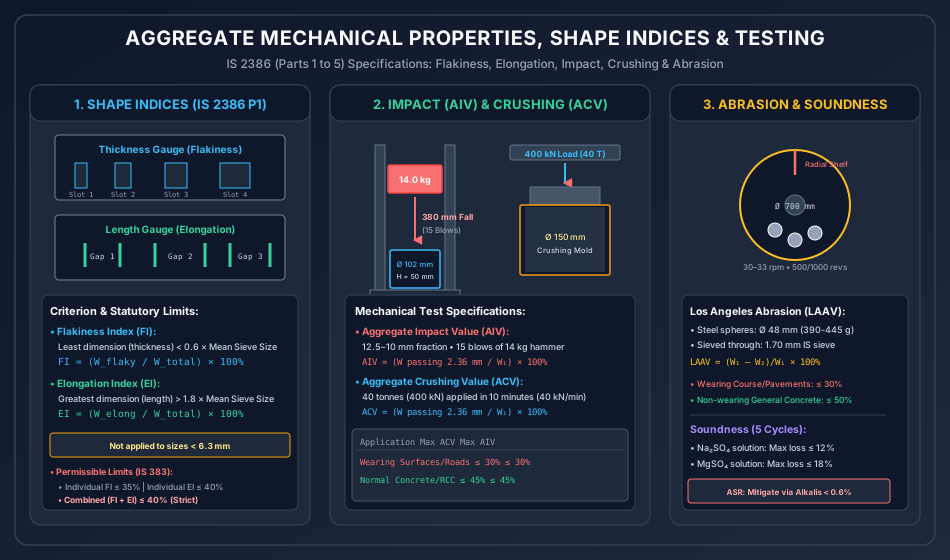
- 4.1 Flakiness Index (FI) (IS 2386 Part 1)
- 4.2 Elongation Index (EI) (IS 2386 Part 1)
- 4.3 Statutory Conformance Limits (IS 383:2016 Table 1)
- 4.4 Specific Gravity, Density & Voids (IS 2386 Part 3)
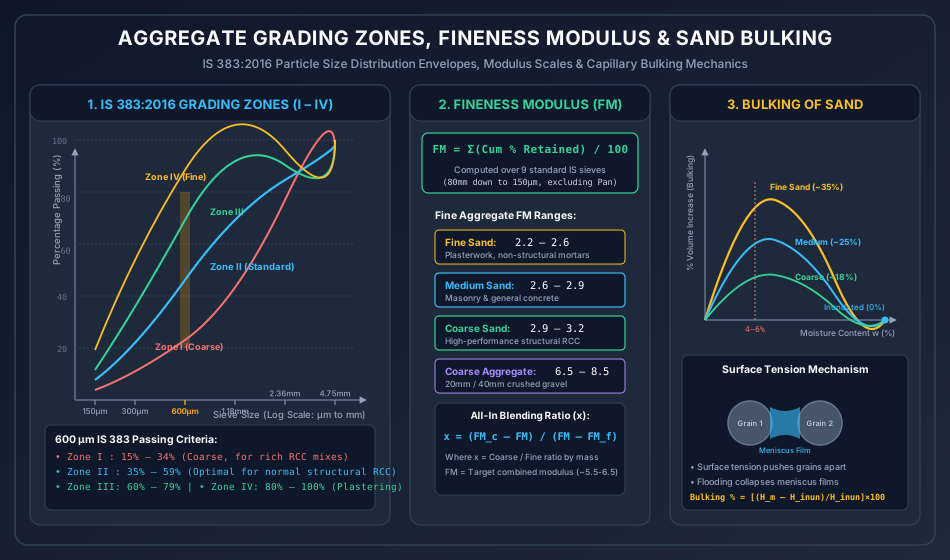
- 4.5 Bulking of Sand (Capillary Meniscus Mechanics)
- 5. Mechanical Strength, Toughness, Hardness & Durability Tests
- 5.1 Aggregate Crushing Value (ACV) (IS 2386 Part 4)
- 5.2 Aggregate Impact Value (AIV) (IS 2386 Part 4)
- 5.3 Los Angeles Abrasion Value (LAAV) (IS 2386 Part 4)
- 5.4 Summary of Statutory Mechanical Limits (IS 383:2016 Table 2)
- 5.5 Alkali-Aggregate Reaction (AAR / Alkali-Silica Reaction ASR)
- 6. Sieve Analysis, Fineness Modulus & IS 383:2016 Grading Zones
- 6.1 Sieve Analysis & Fineness Modulus (FM) (IS 2386 Part 1)
- 6.2 Fineness Modulus Classification for Fine Aggregates
- 6.3 IS 383:2016 Fine Aggregate Grading Zones (I to IV)
- 6.4 Mathematical Blending of Multi-Source Aggregates
- 7. Mortar Technology & Properties
- 7.1 Definition & Functions of Mortar
- 7.2 Mortar Classifications & Formulations
- 7.3 Standard Mortar Mix Proportions
- 7.4 Workability & Flow Table Test (IS 2250)
- 7.5 Compressive Strength Grades of Mortar (IS 2250 Table 1)
- 8. Solved Numerical Problem 1: Sieve Analysis, Fineness Modulus & Blending
- Problem Statement
- Step-by-Step Analytical Solution
- 9. Solved Numerical Problem 2: Flakiness, Elongation & Los Angeles Abrasion
- Problem Statement
- Step-by-Step Analytical Solution
- 10. Solved Numerical Problem 3: Sand Bulking Mechanics & Volume Batching
- Problem Statement
- Step-by-Step Analytical Solution
- 11. Common Misconceptions, Pitfalls & Field Traps
- 12. Multi-Exam Comparative Summary & High-Yield Facts Table
- 13. Comprehensive Glossary of Technical Terms
- 14. References & Standard Codes
1. Topic Title & Authoritative References
Title: Comprehensive Science of Concrete Aggregates: Geological Origins, Particle Morphology, Geometric Shape Indices, Mechanical Strength & Durability Tests, IS 383:2016 Sieve Analysis & Grading Zones, Bulking Mechanics, and Masonry Mortar Technology.
Primary Standards & Authoritative Specifications:
- IS 383:2016: Coarse and Fine Aggregate for Concrete — Specification (Third Revision).
- IS 2386 (Parts 1 to 8): Methods of Test for Aggregates for Concrete (Part 1: Particle Size & Shape; Part 2: Estimation of Deleterious Materials; Part 3: Specific Gravity, Density, Voids; Part 4: Mechanical Properties; Part 5: Soundness; Part 6: Measuring Mortar Making Properties; Part 7: Alkali-Aggregate Reactivity).
- IS 2250:1981: Code of Practice for Preparation and Use of Masonry Mortars.
- IS 1542:1992: Sand for Plaster — Specification.
- ASTM C33 / C33M: Standard Specification for Concrete Aggregates.
2. Prerequisites & Learning Objectives
Prerequisites
- Basic geology: classification of rock types (igneous, sedimentary, metamorphic).
- Mechanics of materials: crushing, impact energy dissipation, shear resistance, and surface friction.
- Surface chemistry: surface tension, capillary meniscus forces, and moisture adsorption.
Learning Objectives
- Classify aggregates by geological origin, size fractions (fine vs. coarse), particle shape (rounded, irregular, angular, flaky, elongated), and surface texture.
- Determine shape indices per IS 2386 Part 1: Flakiness Index () using the thickness gauge and Elongation Index () using the length gauge, verifying statutory compliance ().
- Formulate the mechanics of capillary bulking of sand, evaluating volumetric expansion curves and calculating field volume batching corrections.
- Execute mechanical evaluations per IS 2386 Part 4: Aggregate Crushing Value (), Aggregate Impact Value (), and Los Angeles Abrasion Value (), linking results to wearing surface and structural concrete limits.
- Perform sieve analysis, calculate Fineness Modulus (), categorize fine aggregates into IS 383:2016 Grading Zones (I, II, III, IV), and execute mathematical blending of multi-source aggregates.
- Design and evaluate masonry mortars per IS 2250: proportioning, workability flow table testing, and compressive strength grades (MM 0.7 to MM 7.5).
3. Classification, Particle Shape & Surface Texture
Aggregates occupy of total concrete volume, forming the rigid skeleton that resists compressive stresses, minimizes drying shrinkage, and dictates economy.
Aggregate Classifications:
• Fine Aggregate: Passing 4.75 mm IS sieve, retained on 150 µm sieve (IS 383)
• Coarse Aggregate: Retained on 4.75 mm IS sieve (standard nominal sizes: 10, 20, 40 mm)
• All-In Aggregate: Naturally occurring combined mixture of fine and coarse fractions
3.1 Geological Origin & Mineralogy
- Igneous Rocks: Granite, Basalt, Trap, Dolerite, Pumice. Possess crystalline texture, high compressive strength (), low porosity, and high durability. Ideal for structural and pavement concrete.
- Sedimentary Rocks: Sandstone, Limestone, Shale. Stratified structures. Sandstone and dense limestone make acceptable aggregates; clayey shales and chalk are weak, porous, and strictly prohibited.
- Metamorphic Rocks: Quartzite, Gneiss, Schist, Marble. Foliated structures. Quartzite is exceptionally hard and durable; schists and slates are laminated and produce excessive flaky particles.
3.2 Particle Shape Classification (IS 2386 Part 1)
| Particle Shape Category | Geometric Characteristics & Natural Occurrence | Percentage of Voids | Impact on Workability & Water Demand | Structural Performance & Strength |
|---|---|---|---|---|
| Rounded | Riverbed gravels, wind-blown seashore sands; rounded by water attrition. | (Lowest) | Excellent workability; minimum water-cement ratio; lowest cement paste demand. | Low interlocking; poor mechanical bond; lower flexural tensile strength. |
| Irregular | Partially attritioned gravels, pit sand with rounded edges. | Moderate workability; requires slightly more paste than rounded aggregates. | Intermediate bond and strength. | |
| Angular | Crushed quarried rocks with sharp, well-defined edges and planar faces. | High inter-particle friction; demands more water/plasticizer for equal slump. | Highest mechanical interlocking; superior compressive and flexural tensile strength. Preferred for high-strength concrete. | |
| Flaky | Thickness is relatively small compared to other dimensions. | Severely degrades workability; causes high paste demand. | Weak plane of fracture; breaks under roller/traffic; causes bridging voids. | |
| Elongated | Length is substantially greater than width and thickness. | Causes interlocking jams in pumps and chutes; severe bleeding. | High bending moments under wheel loads; easily fractures in concrete. |
3.3 Surface Texture Classifications
- Glassy: Black flint, glassy slag (extremely smooth; poorest paste adhesion).
- Smooth: River gravels, marble (low bond strength).
- Granular: Sandstone, fine-grained granite (uniform friction, good bond).
- Crystalline: Coarse granite, basalt, dolomite (strong paste-aggregate interlock).
- Rough / Honeycombed: Pumice, scoria, expanded blast-furnace slag (highest chemical-mechanical bond, high absorption).
4. Geometric Shape Indices & Physical Properties
4.1 Flakiness Index () (IS 2386 Part 1)
The Flakiness Index is the percentage by mass of aggregate particles whose least dimension (thickness) is less than of their mean sieve size.
- Apparatus: Standard Sheet Metal Thickness Gauge containing calibrated rectangular slots.
- Test Size Range: Conducted strictly on aggregate fractions between and . (Particles smaller than are excluded as testing is non-reproducible).
- Procedure: A minimum sample of pieces of each size fraction is weighed (). Each particle is tested by attempting to pass it through the corresponding slot of the thickness gauge. The total mass passing the slots is weighed ().
- Formula:
4.2 Elongation Index () (IS 2386 Part 1)
The Elongation Index is the percentage by mass of aggregate particles whose greatest dimension (length) is greater than of their mean sieve size.
- Apparatus: Standard Length Gauge comprising calibrated vertical metal pins mounted on a hardwood/metal baseboard.
- Test Size Range: Conducted strictly on fractions between and .
- Procedure: The non-flaky particles from each size fraction are tested. Particles that fail to pass lengthwise between the corresponding gauge pins (i.e., retained) are collected and weighed ().
- Formula:
4.3 Statutory Conformance Limits (IS 383:2016 Table 1)
- Individual Flakiness Index: for uncrushed gravels; for crushed stone.
- Individual Elongation Index: .
- Combined Flakiness & Elongation Index (): for pavement wearing courses and structural concrete. (Excess flakiness causes segregation, honeycombing, and brittle shear failure).
4.4 Specific Gravity, Density & Voids (IS 2386 Part 3)
- Specific Gravity Formulations:
- Bulk Specific Gravity (Oven-Dry, ): Where is oven-dry mass (), is saturated surface-dry (SSD) mass in air, and is mass of saturated sample in water. Typical range: .
- Apparent Specific Gravity (): Considers solid stone volume excluding permeable pore spaces:
- Water Absorption: IS 383 Statutory Requirement: Maximum permissible water absorption (up to allowed for non-wearing concrete). Higher values indicate porous, weathered, frost-susceptible aggregates.
4.5 Bulking of Sand (Capillary Meniscus Mechanics)
Bulking is the volumetric increase of a given mass of fine aggregate caused by the formation of adhesive water films around individual sand grains.
- Physical Mechanism:
- When moist sand () is dumped loosely, surface tension forms convex capillary water menisci at contact points between adjacent grains.
- The negative pore pressure (capillary tension) acts normal to grain surfaces, pushing them apart against gravity and preventing close packing.
- The void ratio increases drastically, swelling the apparent bulk volume by .
- Moisture-Bulking Characteristics:
- Peak Bulking Point: Occurs at an optimal moisture content of .
- Effect of Particle Size: Finer sands possess vastly higher specific surface areas; thus, fine sand bulkes substantially more () than coarse sand ().
- Complete Inundation (Flooding): At higher moisture contents (), water fills all inter-particle voids. Menisci collapse completely; surface tension vanishes, and sand grains settle into their true dense dry-packing volume ().
- Engineering Danger of Volume Batching:
- If concrete is batched by volume without correcting for bulking, a measured volume contains far less actual sand grains than specified.
- The mix becomes cement-rich, highly unworkable, prone to segregation, and yields a severe shortfall in concrete volume output.
- Field Test & Bulking Ratio (): A graduated cylinder is filled with moist sand to height . Water is added to submerge the sand completely, and it is stirred thoroughly to release trapped air and collapse menisci. The settled inundated height is .
5. Mechanical Strength, Toughness, Hardness & Durability Tests
5.1 Aggregate Crushing Value () (IS 2386 Part 4)
Measures the resistance of aggregates to progressive compressive crushing under a gradually applied quasi-static compressive load.
- Sample Preparation: Oven-dried aggregate fraction passing and retained on IS sieve.
- Apparatus: Steel cylinder of internal diameter with heavy base plate and plunger. Filled in 3 equal layers, each tamped 25 times with a bullet-headed rod.
- Loading: Tested in a Compression Testing Machine (CTM). Subjected to a total compressive load of () applied uniformly at a constant rate of over exactly .
- Sieving: Crushed material sieved through a standard IS sieve.
- Formula: Where is initial dry mass (), and is mass of fines passing sieve.
5.2 Aggregate Impact Value () (IS 2386 Part 4)
Measures the dynamic toughness and resistance of aggregates to sudden shock or impact loading.
- Sample Preparation: Material passing and retained on sieve, packed into a standard steel cup of internal diameter and depth.
- Apparatus: Impact testing machine with a hammer dropping vertically through a free-fall height of .
- Procedure: Sample subjected to delivered at an interval of not less than . Crushed material sieved through a IS sieve.
- Formula:
5.3 Los Angeles Abrasion Value () (IS 2386 Part 4)
Measures the surface hardness and resistance to mutual attrition and mechanical wear caused by traffic and mixing actions.
- Apparatus: Hollow steel cylinder of internal diameter and length, mounted horizontally on stub shafts. Contains an internal longitudinal radial shelf projecting into the cylinder.
- Abrasive Charge: Specific number of cast iron or steel spheres of diameter and mass each ( to spheres, depending on grading).
- Operation: Rotated at a uniform speed of for ( revolutions for large stone macadam).
- Sieving: Discharged material sieved on a IS sieve.
- Formula:
5.4 Summary of Statutory Mechanical Limits (IS 383:2016 Table 2)
| Mechanical Property & Test | Wearing Surfaces, Highway Pavements, Runways | Heavy-Duty Industrial Concrete Floors | Non-Wearing Structural Concrete / RCC |
|---|---|---|---|
| Aggregate Crushing Value () | |||
| Aggregate Impact Value () | |||
| Los Angeles Abrasion Value () | |||
| Soundness (, 5 cycles) | |||
| Soundness (, 5 cycles) |
5.5 Alkali-Aggregate Reaction (AAR / Alkali-Silica Reaction ASR)
ASR is an internal chemical degradation phenomenon occurring between reactive amorphous siliceous minerals in aggregates and the soluble alkali metal hydroxides () in cement pore fluids.
- Chemical Mechanism:
- Reactive silica minerals (opal, chalcedony, cristobalite, tridymite, strained quartz) dissolve in high-pH pore water ():
- The formed alkali-silica gel is strongly hydrophilic; it imbibes moisture from the surrounding environment, generating massive osmotic swelling pressures () that exceed the tensile capacity of concrete.
- Physical Manifestations:
- Irregular map cracking (pattern cracking) across structural surfaces.
- Gel exudations from cracks forming white crystalline efflorescent fringes.
- Pop-outs where surface aggregate particles shear off with conical mortar spalls.
- Mitigation Strategies:
- Limit total equivalent alkali content in cement to ().
- Incorporate mineral admixtures: Fly ash (), GGBS (), or Silica Fume (). These consume free and bind alkalis into low-expansion C-S-H hydrates.
- Maintain concrete dry (relative humidity ).
6. Sieve Analysis, Fineness Modulus & IS 383:2016 Grading Zones
6.1 Sieve Analysis & Fineness Modulus () (IS 2386 Part 1)
Sieve analysis determines the particle size distribution by separating an aggregate sample through a nested column of square-mesh wire cloth sieves arranged in decreasing order of aperture size.
- Standard Sieve Column for Concrete:
- Fineness Modulus Formulation: Fineness Modulus is an empirical index obtained by dividing the sum of cumulative percentages of aggregate retained on the nine standard sieves (excluding the pan) by 100:
- Physical Significance: An increase of in represents a doubling of the average particle size (one standard sieve step up).
6.2 Fineness Modulus Classification for Fine Aggregates
| Fine Aggregate Type | Fineness Modulus () Range | Granulometric Suitability & Applications |
|---|---|---|
| Fine Sand | Plastering, pointing, lean bedding mortars. Unsuitable for structural concrete alone due to extreme surface area. | |
| Medium Sand | General masonry work, standard reinforced concrete mixtures. | |
| Coarse Sand | Heavy structural RCC, high-strength concrete mixes. | |
| Unacceptable Sand | Fails IS 383; causes extreme shrinkage () or severe harshness/bleeding (). |
- Coarse Aggregate Ranges:
- nominal size:
- nominal size:
- Combined aggregate for normal RCC:
6.3 IS 383:2016 Fine Aggregate Grading Zones (I to IV)
IS 383:2016 establishes four fine aggregate grading zones based on particle size distribution. The definitive benchmark classifying the zone is the percentage passing through the sieve:
| IS Sieve Aperture Size | Zone I (Coarse) Passing % | Zone II (Medium) Passing % | Zone III (Medium-Fine) Passing % | Zone IV (Fine) Passing % |
|---|---|---|---|---|
| (Key Diagnostic Sieve) | ||||
- Zone I: Coarsest grading. Used for heavy structural concrete with high water-reducing admixtures.
- Zone II: Optimum grading envelope for standard RCC and prestressed concrete.
- Zone III: Moderately fine. Requires careful fine-to-coarse aggregate proportioning.
- Zone IV: Very fine sand. Prohibited in reinforced concrete except where trial mixes establish acceptable performance; extensively used for masonry plastering.
6.4 Mathematical Blending of Multi-Source Aggregates
When blending two aggregates (e.g., coarse aggregate with fineness modulus and fine aggregate with ) to achieve a target combined fineness modulus :
Where is the ratio of coarse aggregate to fine aggregate by mass ():
7. Mortar Technology & Properties
7.1 Definition & Functions of Mortar
Mortar is an intimate paste of one or more binding materials (cement, lime), fine aggregate (sand, surkhi), and water, mixed in predetermined proportions.
- Primary Structural Roles: Binds masonry units (bricks, stones, concrete blocks) into a monolithic structural wall; distributes loads uniformly across bedding planes; fills vertical and horizontal joints to prevent rain ingress; provides decorative plaster finishes.
7.2 Mortar Classifications & Formulations
- Cement Mortar: Portland cement sand. High compressive strength, rapid hardening, hydraulic setting. High drying shrinkage; requires rigorous water curing for 7–14 days.
- Lime Mortar: Hydraulic lime or fat lime sand. Excellent plasticity, superior water retention, self-healing microcracks. Slow strength development; fat lime cannot harden under damp/submerged conditions.
- Gauged Mortar (Composite / Lime-Cement Mortar): Cement lime sand (e.g., or ). Combines the high initial strength of cement with the buttery workability, superior water retention, and crack resistance of lime.
- Surkhi Mortar: Lime surkhi (finely ground burnt clay bricks). Surkhi acts as an active artificial pozzolana, imparting hydraulic properties to fat lime.
7.3 Standard Mortar Mix Proportions
- Reinforced Brickwork / Heavy Structural Arches: or cement mortar.
- Load-Bearing Brick Masonry (Dense External Walls): or cement mortar, or gauged mortar.
- Internal Non-Load Bearing Partitions: cement mortar.
- External Plastering (Two Coats): Undercoat or ; Finishing coat .
- Ceiling Plastering: cement mortar with fine sand.
- Masonry Pointing: or cement mortar.
7.4 Workability & Flow Table Test (IS 2250)
Mortar workability is measured by the Flow Test:
- A conical brass mold ( base dia, top dia, height) is placed on a circular bronze flow table, filled with mortar in 2 layers, and struck off flush.
- The mold is lifted vertically, and the table is dropped through a height of exactly 25 times in 15 seconds.
- The diameter of the spread mortar is measured along 4 directions ().
- Flow Percentage: Standard acceptable masonry mortar flow: .
7.5 Compressive Strength Grades of Mortar (IS 2250 Table 1)
Determined by crushing standard (or ) cubes cured for 28 days:
| Mortar Grade | Characteristic 28-Day Compressive Strength () | Typical Standard Proportions (Cement : Lime : Sand) |
|---|---|---|
| MM 7.5 | (Cement : Sand) or | |
| MM 5.0 | or | |
| MM 3.0 | (Standard gauged mortar) | |
| MM 1.5 | ||
| MM 0.7 | or pure lime-sand mortar |
8. Solved Numerical Problem 1: Sieve Analysis, Fineness Modulus & Blending
Problem Statement
A laboratory sample of of dry fine aggregate is sieved through a nest of standard IS sieves per IS 2386 Part 1. The masses retained on each sieve are recorded as follows:
- :
- :
- :
- :
- :
- :
- :
- Pan:
Determine:
- Complete granulometric table showing mass retained, percentage retained, cumulative percentage retained, and cumulative percentage passing each sieve.
- The Fineness Modulus () of the sand sample and categorize its textural classification.
- The IS 383:2016 Grading Zone of the sand based on the sieve passing percentage.
- If this fine aggregate is to be blended with a crushed coarse aggregate having a Fineness Modulus to produce a combined aggregate grading of target modulus , calculate the required proportion of fine aggregate by mass.
Step-by-Step Analytical Solution
Step 1: Granulometric Sieve Analysis Table
Total initial dry mass . Sum of retained fractions:
| IS Sieve Size | Mass Retained (g) | Individual Retained % | Cumulative Retained % | Cumulative Passing % |
|---|---|---|---|---|
| Pan |
Step 2: Calculation of Fineness Modulus ()
Fineness Modulus is calculated by summing the cumulative percentages retained on the standard sieves (excluding the pan) and dividing by 100:
Textural Categorization: Since , this aggregate is classified as Medium Sand, ideal for normal reinforced concrete.
Step 3: IS 383:2016 Grading Zone Classification
Examining the key diagnostic sieve of :
Comparing against IS 383 limits:
- Zone I:
- Zone II:
- Zone III:
- Zone IV:
Since , the fine aggregate strictly falls into Grading Zone II, the premier standard zone for structural concrete.
Step 4: Proportioning of Blended Aggregates
Given:
- Coarse Aggregate:
- Fine Aggregate:
- Target Combined Modulus:
Using the blending formula:
Result: The optimal blend requires fine aggregate and coarse aggregate by dry mass.
9. Solved Numerical Problem 2: Flakiness, Elongation & Los Angeles Abrasion
Problem Statement
A crushed basalt coarse aggregate sample of total mass is tested for shape characteristics and mechanical abrasion:
- Shape Index Evaluation:
- Fraction passing and retained on sieve: Mass . Mass passing thickness gauge slot ; mass retained on length gauge pins .
- Fraction passing and retained on sieve: Mass . Mass passing thickness gauge slot ; mass retained on length gauge pins .
- Los Angeles Abrasion Test:
- An identical sample is placed in the Los Angeles drum with 11 standard steel spheres and rotated for at . The mass retained on the IS sieve after washing and drying is .
Determine:
- The Flakiness Index (), Elongation Index (), and Combined Index ().
- The Los Angeles Abrasion Value ().
- Assess whether this aggregate is acceptable for use in concrete road wearing surfaces as per IS 383:2016.
Step-by-Step Analytical Solution
Step 1: Flakiness Index ()
- Total sample mass: .
- Total mass passing thickness gauge:
- Flakiness Index:
Step 2: Elongation Index ()
- Total mass retained on length gauge:
- Elongation Index:
Step 3: Combined Index Evaluation
Compliance Check (Shape):
- Statutory limit per IS 383: Combined .
- Since , the aggregate comfortably satisfies the shape requirement.
Step 4: Los Angeles Abrasion Value ()
- Initial dry mass: .
- Mass retained on sieve: .
- Mass of abraded fines passing sieve:
- Abrasion Value:
Step 5: Suitability Assessment for Pavement Wearing Surfaces
Per IS 383:2016 Table 2:
- Maximum permissible for wearing surfaces / pavement concrete: .
- Measured value: PASSED.
- Maximum permissible Combined : .
- Measured value: PASSED.
Engineering Conclusion: The crushed basalt aggregate is fully compliant and certified for use in high-performance concrete road wearing courses and airport runways.
10. Solved Numerical Problem 3: Sand Bulking Mechanics & Volume Batching
Problem Statement
A field quality control engineer conducts a bulking test on river sand delivered to a construction site:
- Moist sand is scooped into a deep graduated cylindrical container without tamping until filled to a level height of .
- Water is added to the container until the sand is completely flooded and inundated. The container is vigorously rodded to displace all air and collapse capillary menisci. The final settled height of the inundated sand is .
- Calculate the percentage bulking of the sand.
- If a nominal concrete mix specification requires of dry sand per batch, determine the actual loose volume of moist sand that must be measured in the field gauge boxes to prevent under-sanding of the mix.
Step-by-Step Analytical Solution
Step 1: Calculation of Bulking Percentage
When sand is completely inundated, the surface tension menisci collapse entirely, and the sand compacts to its true dry volume:
Step 2: Volume Batching Correction Factor
Because each unit volume of moist sand contains only of solid sand grains:
For :
Step 3: Analysis of Error if Correction is Neglected
If the field supervisor inadvertently measures only of moist sand:
- Actual solid sand supplied:
- Shortfall in Fine Aggregate:
- Consequences: The fresh concrete will suffer from severe under-sanding, resulting in harshness, honeycombing, high void content, and a reduction in concrete volumetric yield.
11. Common Misconceptions, Pitfalls & Field Traps
-
The Fineness Modulus Pan Trap:
- The Trap: Summing the cumulative percentage retained including the pan when calculating Fineness Modulus.
- The Reality: The pan always has cumulative retained. If included, the calculated will erroneously increase by (). The summation is conducted strictly over the standard 9 (or 10) sieve sizes excluding the pan!
-
Flakiness Testing of Fine Aggregate:
- The Trap: Attempting to measure flakiness on sand ().
- The Reality: Flakiness and Elongation gauges are standardized strictly down to . No aggregate fraction passing is ever tested for flakiness.
-
Inundation vs. Dry Volume:
- The Trap: Believing that completely flooded sand has a larger volume than dry sand.
- The Reality: Completely inundated sand has practically the same volume as completely dry sand () because water eliminates the surface tension films that cause bulking.
-
Angular vs. Rounded Strength Paradox:
- The Trap: Assuming rounded aggregates make stronger concrete because they require less water for the same slump.
- The Reality: While rounded aggregates require less water, their smooth, non-interlocking surfaces yield lower interfacial transition zone (ITZ) bond strength. Angular crushed aggregates exhibit high mechanical interlock and superior flexural and compressive strength, provided workability is achieved via superplasticizers.
-
Alkali-Silica Reaction (ASR) Delay:
- The Trap: Assuming that concrete passing 28-day strength tests is immune to ASR.
- The Reality: ASR is a slow-motion cancer of concrete; destructive swelling usually manifests after construction when structures are exposed to moisture. Accelerated mortar bar tests (ASTM C1260 / IS 2386 Part 7) at in are necessary to detect potential reactivity.
12. Multi-Exam Comparative Summary & High-Yield Facts Table
| Parameter / Topic | GATE CE Focus | UPSC ESE Focus | SSC JE / State AE Focus | RRB JE Focus |
|---|---|---|---|---|
| Flakiness Index () | Definition: least dimension ; size cutoff . | Thickness gauge dimensions; combined limit . | Limit: Max ; not applicable below . | Factor: . |
| Elongation Index () | Greatest dimension ; non-flaky sample used. | Length gauge pin spacing; individual limit . | Limit: Max ; test size . | Factor: . |
| Aggregate Impact Value () | Hammer mass , fall , 15 blows; sieve. | Wearing limit ; structural limit . | Hammer mass (); drop height (). | Number of blows: . Sieve: . |
| Crushing Value () | Rate of loading ; total load (). | Wearing , normal ; cylindrical mold . | Total load applied: in . | Test duration: . |
| Los Angeles Abrasion | Steel balls , mass ; sieve . | Wearing , non-wearing ; drum . | Speed: ; revolutions: or . | Sieve size: . |
| Bulking of Sand | Surface tension mechanics; peak at ; zero at inundation. | Fine sand bulks more () than coarse sand (). | Maximum bulking moisture: ; volume increase: . | Cause: Surface tension / moisture film. |
| IS 383 Grading Zones | passing criteria: Zone I (), Zone II (). | Zone III (), Zone IV (); Zone IV unsuitable for RCC. | Key diagnostic sieve: . Zone II for RCC. | Coarsest sand: Zone I; Finest: Zone IV. |
| Fineness Modulus () | Blending equation ; Pan excluded. | Sand ranges: Fine (), Medium (), Coarse (). | Range of for medium sand: . | Standard number of sieves: or . |
13. Comprehensive Glossary of Technical Terms
- Fine Aggregate: Aggregate passing the IS sieve and predominantly retained on the IS sieve.
- Coarse Aggregate: Aggregate predominantly retained on the IS sieve (standard commercial sizes: ).
- All-In Aggregate: Naturally occurring or premixed aggregate containing substantial proportions of both fine and coarse sizes.
- Flakiness Index (): Percentage by mass of aggregate particles whose least dimension (thickness) is less than times their mean sieve size.
- Elongation Index (): Percentage by mass of aggregate particles whose greatest dimension (length) is greater than times their mean sieve size.
- Fineness Modulus (): An empirical index representing the weighted average particle size, computed as the sum of cumulative percentages retained on standard sieves divided by 100.
- Capillary Bulking: Volumetric expansion of fine aggregate caused by surface tension films around grains separating them against gravity at moisture contents of .
- Inundation: Complete flooding of sand with water that collapses capillary water films, restoring the true dry packing volume.
- Aggregate Crushing Value (): Percentage by mass of fines passing a sieve after subjecting a cylinder of aggregate to a load over 10 minutes.
- Aggregate Impact Value (): Percentage by mass of fines passing a sieve after subjecting an aggregate sample to 15 blows of a hammer falling from .
- Los Angeles Abrasion Value (): Percentage wear loss passing a sieve after rotating aggregate with steel spheres in a drum for 500 or 1000 revolutions.
- Alkali-Silica Reaction (ASR): Chemical expansion reaction between alkali hydroxides in cement pore water and reactive amorphous silica in aggregates, forming swelling gel.
- Gauged Mortar: A composite mortar containing both Portland cement and lime as binders to optimize early strength, workability, and moisture retention.
14. References & Standard Codes
- Bureau of Indian Standards (BIS):
- IS 383:2016 — Coarse and Fine Aggregate for Concrete — Specification (Third Revision).
- IS 2386 (Parts 1 to 8) — Methods of Test for Aggregates for Concrete.
- IS 2250:1981 — Code of Practice for Preparation and Use of Masonry Mortars.
- IS 1542:1992 — Sand for Plaster — Specification.
- Neville, A. M. (2011). Properties of Concrete (5th Edition). Pearson Education.
- Shetty, M. S., & Jain, A. K. (2019). Concrete Technology: Theory and Practice (8th Edition). S. Chand Publishing.
- Gambhir, M. L. (2013). Concrete Technology: Theory and Practice (5th Edition). McGraw-Hill Education.